Tuesday, August 30, 2005

Just when you thought it was safe to RSS, he’s back!


Watch what you suck, fella. God may be watching--It would be harder to find a better topic to start off the autumn blogging with than circumcision. I knew you’d agree.

There is a minor brouhaha going on in New York City--and I say minor because it involves a small minority of one community and the issue is clear cut--over an ancient and totally discredited practice involving a mohel, the rabbi who performs circumcisions. The issue is not, I emphasize, circumcision--it involves how it is done. Circumcision binds a Jewish male to the covenant with God and is mandated in the Torah, the five books of Moses. It defines a jewish male. Except for a small group of disconnects, the practice is not controversial in the Jewish community, including among those of us who have had one. There also are clear medical benefits.

Mohels are rabbis trained in the practice. Most are Orthodox but that does not limit their practice. Virtually all Jewish families (perhaps as many as 90%) hire a mohel eight days after the birth of a son. The whole family shows up, the mother leaves the room in terror, the baby (usually anesthetized on wine-soaked cotton) cries, and the whole thing is over in a matter of seconds. The food is usually excellent.

Enter Rabbi Yitzchok Fischer, 57, a mohel in New York City. Three boys, one in Staten Island and twins in Brooklyn, contracted Type-1 herpes after Fischer did the procedure. Using an ancient technique mentioned in the Talmud, Fischer used oral suction to stop the bleeding of the penis. I don’t have pictures. One of the boys involved died of the infection, which can be lethal to infants. It is possible Fischer had a cold sore when he performed the oral suction and the virus was transmitted through his saliva. The practice has been condemned as unsanitary since the 19th century, has been abandoned by most Orthodox mohels and is rejected by nearly every non-Orthodox authority. Using a tube for suction is now the norm and is endorsed by the Rabbinical Council of America, the largest Orthodox rabbinic association. Use of oral suction now resides exclusively in charedi (ultra-Orthodox) communities such as the Hassidim, where it is considered integral to the procedure. These communities say they have no intention of stopping the practice.

(Keep in mind that endangering the life of a child--or any other human for that matter--is the gravest of sins in Jewish law so these people are several entrees short of a kosher combo plate.)

Since February, Fischer has been under court order not to perform the ritual in the city while the health department investigates.

That would seem to be a slam-dunk, but this is New York City and this is an election year. The charedi community is in high dudgeon over the interference by the city and there are a lot of them in New York, particularly in Brooklyn. So, when they pressured Mayor Michael Bloomberg (who is, of course, Jewish, and is running for reelection) for a meeting, he acceded to their request and afterwards issued a statement that sets new records for pandering:

“We’re going to do a study, and make sure that everybody is safe and at the same time, it is not the government’s business to tell people how to practice their religion.”

Yes, but:

• The study already has been done and was published in the journal Pediatrics. There have been eight neonatal infections all traced to oral suction.

• It most certainly is the business of the government to intervene in religious matters when lives are at stake. If a witch doctor in Queens started practicing unsaniary female circumcision and was endangering the lives of girls in the city, would the government say it couldn’t interfere? Alas, there are few witch doctors who vote in New York City.

• And keep in mind, no matter what the charedi rabbis say, the practice violates basic Jewish law. When they wrote the Talmud they didn't know about viruses.

Then again, it is an election year. He is a very wealthy man, and he got wealthy by character and intelligence. He seems to have parked it when he became a politician.

By the way, Christopher Hitchens, with whom I disagree often but also read often, has a column on this is Slate and he is absolutely correct this time.

Friday, August 19, 2005

Mental Health Week


This here blog will be inactive next week as your humble servant and family make their annual pilgrimage to the Berkshire hills of Massachusetts, the Tanglewood Music Festival, Great Barrington (I've always wondered if there is a Less Barrington) and the discount malls of Adams. You are on your own until the 29th or 30th, when action resumes.

Live long and prosper.

JNS

Thursday, August 18, 2005

Flying over Kansas


For those of you following the creationism and intelligent design stuff, here is another website worth bookmarking, along with Panda's Thumb. It's here, CSICOP's Creation and Intelligent Design Watch.

If you live in Kansas, you get a discount.

Fetuses, cold soup and the bar at the center of the galaxy


August 18, 2005


Burning to stir up the abortion controversy--Here we go again. A group of Swiss scientists report in Lancet [subscription required] that they have used human fetal cells as a form of bandage to treat serious burns in children. The bandage was derived from the skin cells of an aborted fetus and proved, in the test, far superior in encouraging healing than skin grafts. Keeping in mind that the sample size is very small, eight children, the results still are impressive because of the context. Normally, burns are treated by taking skin from part of the patient that was not burned, and grafting it over the burns. That hurts like hell, often leaves serious scars, and doesn’t always work. In this study, scientists at the University Hospital of Lausanne, took artificial fetal skin, grown from a postage-stamp sized sample of skin from a fetus aborted three years earlier. The goal was to use the artificial skin to cover the wounds, just as a graft would. That’s not what happened. The new skin had to be replaced every several days because it dissolved, but the doctors found that the skin restored the damaged tissue which regenerated and healed the wounds. The experiment needs to be replicated and certainly requires tests on a larger number of patients before any real conclusions can be reached--and those experiments won’t happen in the U.S. They would be illegal.


Waiter, there’s life in my soup--Scientists have long puzzled over the inelegance of the human genome. There’s a lot of junk in it, stuff we don’t seem to need and doesn’t appear to serve any purpose, and it seems unnecessarily complex. A group of British scientists [hey, did you notice, science actually gets done in other countries?] think they have an explanation: life formed in hot soup that eventually cooled down. The theory speaks to a 40-year-old puzzle--why does the DNA vocabulary contain 64-three-letter words (codons), when they translate into only 20 amino acids. Seems sloppy and inefficient. Several codons even translate into the same amino acid. The researchers, from the University of Bath reporting in the Journal of Molecular Evolution [I always have it by my bedside], working on an idea from Francis Crick, suggest that the three-letter code evolved from a simpler two-letter code. The original code involved reading only two of the three letters--the first two or the last two. Two amino acids excluded from the doublet system, glutamine and asparagine, appear to be late comers. Neither can hold their molecules together in high temperatures, so the researcher theorize they formed after the hot soup cooled down, complicating the rise of life.


So set ‘em up Joe, I’ve got a little story I want you to know--The bar at the center of the galaxy sounds like a Douglas Adams sequel but it isn’t. It’s a odd-shaped cluster of stars. Long and narrow (we are using relative terms here), it cuts through the Milky Way and is even bigger than anyone thought. Keep in mind, this is really huge: 27,000 light years in length, about 7,000 light years longer than originally thought. It’s comprised of old and red stars, according to researchers at the University of Wisconsin-Madison [I thought I’d throw in some American science here so everyone would feel better]. It sits at a 45-degree angle between our sun and the center of the galaxy and is a structure considered fairly rare in the known universe. It was found by the orbiting Spitzer Space Telescope. Most astronomers thought the center of the galaxy was spiral. Nope. There’s a bar there. Don’t panic.

Sunday, August 14, 2005

That's Schroedinger's cat mewing on the porch


August 14, 2005

I'll take a vowel, Vanna, and then I'll know less--What if I gave you information that would result in your knowing less than you did before I gave it to you--negative information? Can there be such a thing? Well, yes, in the quantum world, anything is possible.

Jonathan Oppenheim at Cambridge has a wonderful webpage describing negative information, how you can actually reduce knowledge by adding to it. It's great fun--if you believe in quantum mechanics or existentialism.

Oppenheim points out that in information theory, “this dude Claude Shannon” pointed out that understanding information is less important than understanding how much there is. Give an information theorist a copy of War and Peace, and she would say, “gosh, that’s a lot of information.” [Woody Allen once said he took a speed-reading coure and read Moby Dick in 15 minutes. It’s about a whale.] A message with 10 letters doesn’t transmit a lot, so Shannon defined information as the minimum amount of letters needed to convey a message, irrespective of how it is delivered.

Think of the television show “Wheel of Fortune,” in which you have to guess a sentence as letters are added to a matrix. Once you have the meaning of the sentence, the rest of the letters are irrelevant. "Wheel of Fortune" uses information theory. Now consider there is something called prior information--knowing some of the letters before the game began--and partial information--the number of letters you need before you know the sentence. Got it?

OK, but the quantum world is different. It is, you should pardon the expression, existential. In Erwin Schroedinger’s wonderful quantum cat mind exercise, the answer to the question, is the cat alive or dead, is yes. Is an object here or there? Yes. It could also be neither here nor there. Einstein found that notion repulsive, but generally, that’s what physicists think is the nature of nature when dealing with very small objects. Feynman (stealing from von Neumann), is rumored to have said that "you don't understand quantum mechanics, you just get used to it." Also keep in mind, that quantum objects are fragile. Look at one, and it stops being quantum. An electron can be pointing up and down simultaneously. The moment you look at it, it is either one or the other, or with Schroedinger’s cat, it is either dead or alive. So, if you decide that an electron pointing up is a 1 and one pointing down is a 0, the first person who looks at the electron removes it from its quantum state and decides it is one or the other. That’s why quantum computing is so difficult.

OK, now negative information. A mythical Bob in Oppenheim’s paper, has some prior information so that when the equally mythical Alice wants to send him a message, we can figure out how much information she must send before he understands the message. That’s tough because Alice doesn’t know what Bob knows, and in the quantum world, Alice doesn’t even know what Alice knows. [Alice is a good choice of names for this exercise]. Oppenheim uses a new adjective to decribe this, "Rumsfeldeque." Love it.

He then points out that the equation used to quantify how much information Alice has to send--how much partial information is required for Bob to understand the message--can produce a negative number. Huh?

Well, you probably are going to have to read this more thoroughly on your own, but here is Oppenheim’s example from his web page.

Information is always information about something. This can be expressed in terms of correlations. If you have either a white or a black ball, and I claim to know the color of your ball, then there is an easy test to figure out whether I really know something. I write the color of your ball on a piece of paper, and you put your ball in a box. Then we give the piece of paper and the box to a referee, who checks whether the color I wrote on the paper is the same as the color of the ball in the box. The referee can determine that I know something about what you have. If we repeat this test over and over again, the fact that I have information about your ball, will manifest itself in the fact that the referee will always find that the color I wrote on the piece of paper will be correlated with the color of the ball you gave her.

Now let us imagine that you give me your ball. Now I still know something, because the color on my piece of paper (and the ball I have), is correlated with your brain, which remembers what the color of the ball was. So by giving me the ball, you haven't changed anything: a referee can still perform a test to determine if I know something. The referee will ask me for the piece of paper, and ask you to write down the color of the ball you sent me. If they match, we have proved to the referee that I know something about what you have (or had).

But if the balls were quantum particles, then it can sometimes be that there is no memory of what color they are. A quantum ball can be completely isolated from anything which might record a memory of its color....

Now let us imagine that you have a quantum ball, which is black or white, and I have a piece of paper where it is written what color the ball is. Then I have some information, because my piece of paper is correlated with your ball. We could convince the referee that I know something about what you have. But if you give me the ball, then I will no longer have any correlations with things external to me. You have no memory of the color of the ball, and so there is no test we can perform with the referee which will prove that I knew something. By giving me the ball (giving me information), I now know less!

And, now, I think, I do too. Well, not really.

While we're on the subject of the weird and fascinating, may I recommend this? Report back.

Thursday, August 11, 2005

We're capitalists; we won't hurt you


August 11, 2005

Don’t worry about yourself, think of the cockroaches--The proposed changes by the Environmental Protection Agency to protect human subjects in insecticide studies, is under attack from environmentalists, their own scientists, and Congress. No, not those old proposals. The new ones, the ones that were supposed to correct flaws in the first proposals. Several critics call it a sell-out to the industry, which of course is absurd--government wouldn’t do that, would they? Earlier this year, Congress lambasted the EPA’s proposed guidelines to protect human subjects, noting health risks and ethical lapses in the industry-supported plan. The EPA promised to go back and redo the proposals to take those concerns into consideration. The Baltimore Sun, however, reports today it has a copy of the 76-page draft of the new proposals and the EPA apparently either wasn’t paying attention or decided to ignore the criticism. Although the introduction contains wording say was going to propose tighter rules, the Sun says the text doesn’t come close. Even the agency’s own scientists are appalled. “This is a very important ethical, scientific and clinical issue,” one said, “and they are trying to fool the American public about its intent. It’s a magician’s trick.” [As an aside, the fact that scientist was an unnamed source is a good example of why reporters need to have unnamed sources and protect them]. Environmentalists say the rules have so many loopholes they are essentially meaningless. The proposal came from a congressional study that reviewed 22 EPA-related human studies conducted by the pesticide industry. The study found that in many cases the test subjects didn’t know what they were being exposed to or, in many cases, why the tests were being done. The study also found that some of the tests did not follow accepted ethical standards. Some of the test subjects at risk included pregnant women and children. An EPA spokeswoman said she couldn’t comment as it was only a draft proposal.

Wednesday, August 10, 2005

"You don't like me! You really don't like me!"--UPDATED


August 10, 2005


Well, they never call me--Too much is made of polling, or at least of individual polls. There is the common tendency to reject the ones that come to conclusions you don’t like or agree with (”the only poll that counts is the one on election day”) and embrace the ones that show you are definitely among the intelligent elite. And then there is the disbelief that you can make 1,500 telephone calls and tell what 300 million people are thinking. [Your humble servant was actually trained to do exactly that at a program at Northwestern University back in the last Nixon year]. Whether you believe individual polls or not, you sometimes run into a meta-analysis of polls--a study of lots of polls asking similar questions--and you come up with some interesting and believable stuff. Mark Blumenthal and his excellent blog, Mystery Pollster, has done just that. His essay was triggered by an op-ed piece in the New York Times by the Pew’s Andrew Kohut and Peter Hoey, that compares public opinion and major events during the first half-year of the second term for Presidents Nixon, Reagan Clinton and Bush. As Blumenthal points out, the graphic that goes with it is amazing. Essentially, it shows that President Bush’s approval rating is the lowest of any president in a second term with the exception of Richard Nixon who was being swallowed by Watergate. It’s down to 44 percent in the Pew poll. If, however, you go and combine all the respected national polls and plot them on one chart, they all--with one exception--show essentially a similar result:

Bush’s approval spiked naturally at 9/11 and quickly began to slide. That’s expected; no one would think any president could keep that high an approval as we moved away from the attack. It took another uptick with the capture of Saddam Hussein. It rose 5-10 points around the election. But the trend throughout Bush’s presidency has been steady and consistent in all but one of the polls--downward. [The exception is the Rasmussen poll, which uses machine voices for interviews in a tracking poll, and neither Blumenthal nor anyone else can explain why it is an outrider, besides the fact is uses robot interviewers. Blumenthal guesses it is because Rasmussen weights his polls by party which doesn’t catch changes in public’s party affiliation. More people are now associating themselves with Democrats then they did several years ago.)

One possible explanation for the downward slide, suggested by Slate’s blogger, Mickey Kaus, is that the polls are simply reflecting the natural approval rating Bush would have if 9/11 never happened. It’s not the war or the economy. It’s Bush. Think, Kaus says, of a baseball hitter who has a hot streak and then regresses back to his natural batting average. Bush has. What he sees it what he gets.

Works for me.

UPDATE: On 8/14, the Rasumussen robots fell into line, making it unanimous.

Tuesday, August 09, 2005

Steroids and the working man


Guest column
By Jon Shurkin
August 9, 2005

Is that a hypodermic needle in your pocket or are you just coming up to bat?—Thanks to Viagra spokesman Rafael Palmiero’s suspension for using performance enhancement drugs, there’s been a lot of squawking about cheating and illegality in baseball, not to mention the old favorite: "won’t somebody think of the children?" In fact, taking a turn through all the ESPN talking sport pundit shows, they’re all comparing this whole thing to the Black Sox scandal of 1919 or Pete Rose’s cheating on baseball. But is it?

A lot of people don’t know what they’re talking about. It may not be so terrible after all.

Quick, what is a steroid? It’s something you inject into your body to make you beefier and stronger, right? Well, err no. Why would doping be soprevalent in the Olympics in sports like swimming or track, where being beefier would be a hindrance not an advantage? Who were the first players to get busted this year for steroids in baseball? None of them were the body builder types. In fact, one of the things that’s being said repeatedlyabout Palmiero was that he didn’t seem like one because he wasn’t unusually big, strong and muscular so he could crush home run balls. Yet crush them he did.

As you listen to all this steroid kerfuffle, remember this: There are, in fact, over 600 types of
steroids, some of them even used for medicinal purposes. The main ones everyone talks about are those related to testosterone, which has the effect of yes, building muscle mass, but also in tissue building. The infamous "cream" often mentioned in the media does nothing but help people recover faster from an injury or the common aches, pains and tiredness that a full season of sports can bring. Roger Clemens, currently in the midst of one of the greatest seasons in baseball history at the tender age of 43, has been named as a doper by Jose Conseco.
But nobody mentions that when they’re all gushing over Roger, who is not the weight-lifter type at all. And when Ryne Sandberg and Wade Boggs gave their Hall of Fame speeches, everyone admired them because they were definitely not on the juice. But how do we know?
Steroids can do more than just make you big and strong. In the most cases, it’s your
normal, average looking guy who could be using them. The fact that everyone is out with pitchforks looking for the bashers shows once again that most people have no idea what
they’re talking about.

But what about the drug Rafael took, which is one of the big, nasty, bend over and inject type drugs. The reality is that nobody knows for sure what they do. They’re not even sure if all those supposed side effects that we keep on hearing about are from taking the steroids or from taking a particularly crappy steroid, the kind of steroid one gets on the black market because of the illegality of steroids. Don’t try the brown acid, indeed. Jose Canseco, reality TV star and the alleged Dr. Feelgood of baseball even writes in his book that he thinks steroids are good for you and that if administered properly can be completely non-harmful and beneficial to the athlete.

Of course, as everyone knows, there was a huge explosion of home runs over the years. Conspiracy fans would claim that baseball was in trouble after the ‘94 strike and so they souped up the ball, juiced up the players, and cranked up the volume. Sammy and Big Mac go after Roger Maris and fans fall back in deep love with American’s Pastime. True, but that era also included smaller ballparks and expansion. Smaller ballparks and expansion always
mean more home runs. Oh, and the man who some people think is the focus of all this, Barry Bonds? Yeah, he hit more home runs at a later age than he did when he was younger but so did Henry Aaron. And a lot of other great ballplayers. The dude worked out. A lot. Is it entirely possible that good conditioning, supplements (some legal, some not so much), incredible
genetics, and twenty years of baseball experience all came together to create an offensive force baseball hasn’t seen since the Babe was chasing hookers through trains?


But it’s cheating, right? Maybe. But say you have a baseball player who uses it to recover quickly from an injury. What’s the difference between doing that and taking cortisone, also a steroid? Or baseball’s deepest, darkest secret ˜uppers. Why is Jason Giambi considered a villain for taking drugs but not Curt Schilling? Schilling, after all, gained baseball immortality
by donning the bloody sock and pitching with a busted ankle. As studly as his performance was, he was also doped up to the beejesus on pain killers. How do football players survive the completely inhuman physical thrashing they do on a weekly basis? Gobs and gobs of pain pills. Ever see "North Dallas Forty?"

In other words, where do we draw the line? It is entirely possible for an athlete to go in and get lasik surgery to improve their eye sight, even going from normal 20-20 to 20-10. What’s the difference between that steroids? It’s also becoming possible for pitchers to get arm surgery to add muscle to their perfectly normal arm. Why? Because of instead of pitching with their however-old-they-are arm, they can add some unused tissues and muscle fromsomewhere else in the body and add it to their arm, thus fixing a lot of wear and tear on the arm. It’s like putting a new engine into a car; old body but newish firepower. Is that cheating? And at some point were about to see stuff involving genetics that will make using steroids seem like a second graders chem lab experiment.

Sure there’s something not right about steroids. And Rafael Palmiero might be the dumbest man in sports right now. But what we have here is a good old fashioned witch hunt, the kind of thing that happens when you combine a hysterical media, bad information, and politicians in blow-hard mode. The future isonly going to make things more complicated and messier, we haven’t even begun to think about all this.

Friday, August 05, 2005

Mr. Galileo, your table is waiting


August 5, 2005

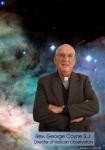
You mean the earth goes around the sun? Who knew?— It seems that the Roman Catholic Church—or at least much of it—learned some lessons from the Galileo Affair, and the battle with those who didn’t is getting public. The British newspaper, The Independent, is reporting that an American Jesuit (who else) is blasting the Archbishop of Vienna (a long-time friend of Pope Benedict XVI) for an op-ed piece he wrote in the New York Times on evolution [no longer posted]. In the article, Cardinal Shönborn said that it is not possible to believe in random evolution—that the life we see around us is the result of random mutations—and be a believer in "God the Creator." "Evolution," he wrote, "in the sense of common ancestry might be true, but evolution in the neo-Darwinian sense—an unguided, unplanned process of random variation and natural selection—is not." That would put him right up there with President Bush, who thinks “intelligent design” needs to be taught in school. According to The Independent, Shöborn’s piece was instigated by Mark Ryland of the Discovery Institution, the mouthpiece for intelligent design. Now Father George Coyne, who happens to be the Vatican astronomer, has gone on the offensive in The Tablet [registration required, click headline], Britain’s Catholic weekly. Fr. Coyne said the article has "darkened the waters" of the rapport between Church and science, and says flatly that "life...has evolved through a process of random genetic mutations and natural selection and that is compatible with God’s dominion...Why does there seem to be a persistent retreat in the Church from attempts to establish a dialogue with the community of scientists?"

"Even today, disquiet still rumbles over the treatment of Galileo, despite the formation of the Galileo Commission to investigate the treatment of the scientist after John Paul II realised that many in the scientific world still believed there was an intrinsic animosity between the Church and science.," he writes.

"We can only come to know God by analogy. The universe as we know it today through science is one way to derive an analogical knowledge of God. For those who believe modern science does say something to us about God, it provides a challenge, an enriching challenge, to traditional beliefs about God. God in his infinite freedom continuously creates a world that reflects that freedom at all levels of the evolutionary process to greater and greater complexity. God lets the world be what it will be in its continuous evolution. He is not continually intervening, but rather allows, participates, loves. Is such thinking adequate to preserve the special character attributed by religious thought to the emergence not only of life but also of spirit, while avoiding a crude creationism? Only a protracted dialogue will tell. But we should not close off the dialogue and darken the already murky waters by fearing that God will be abandoned if we embrace the best of modern science."

That Fr. Coyne felt it permissible to take after the Archbishop of Vienna is, the newspaper said, “unprecedented.” He probably had to clear the article with his Jesuit superiors.

Meanwhile, Paul Krugman in the New York Times, points out that the same technique reactionaries use push forward their agenda with non-science—for example, all those think-tank studies showing that global warming was exaggerated—is being used in the intelligent design debate, trying to foist off non-science as science and then insist there is a controversy when none actually exists. There is no controversy in science over global warming; there is no controversy in science over evolution. Journalists get trapped in the he-said, they-said syndrome in which just because proponents of intelligent design say there is a controversy, they feel obliged to cover it as if there actually was one. There ain’t. Krugman says Irving Kristol (Bill’s father) invented the technique in the 1970s, urging "corporations to make 'philanthropic contributions to scholars and institutions who are likely to advocate preservation of a strong private sector." That was delicately worded, but the clear implication was that corporations that didn't like the results of academic research, however valid, should support people willing to say something more to their liking.”

Thursday, August 04, 2005

Decline of Western Civilization Part VI—The Hummer and the Ice Berg


August 4, 2005

Well, at least it didn’t fall on the White House—The Larsen B ice shelf in Antartca collapsed over the austral summer in an event unprecedented in 10,000 years, according to American and Canadian researchers. You would have to go back to the end of the last ice age to find an equal. According to the paper published in Nature [$], the hunk of ice that fell off the Larsen is about the size of Luxembourg. Cause: probably global warming. In five years, the shelf has shrunk by 5,700 square kilometers (3,500 square miles). The conclusions were based on six ice cores taken from the vicinity of the ice shelf. The shelf has been thinning for years, but apparently reached, you should pardon the expression, a tipping point at the end of March when 50 billion tons fell off into the Weddell Sea, creating thousands of large ice bergs. It all happened in 35 days. The ice is floating so by itself, that won’t raise sea levels, but it could speed up the motion of ice on the land toward the sea which will. Remember that great scene in “The Day After Tomorrow” (an otherwise really stupid movie) in which a tsunami attacks Manhattan? That kind of stuff. But what is our government doing about all of this? Read on.


Let’s skip the details and jump right to the evasions—The U.S., Australia, China and India—countries that are unhappy with the Kyoto protocol, have issued a new pact to develop technologies that will combat global warming by reducing greenhouse gasses, thereby actually eliminating the need to do something. It would make it unnecessary to actually make sacrifices and would finesse the Kyoto protocol, which the U.S. and Australia, alone among developing nations, refuse to adopt. Kyoto demands that greenhouse emissions be cut by 5.2 percent below 1990 levels by 2008. That would require the world’s largest polluter (us) by far to to take real action rather than pass energy bills like the bill it passed last week, which dumped billions of dollars of tax relief to energy companies who make billions in profits every week and takes no action whatsoever. The U.S.’s criticism is that Kyoto doesn’t include developing nations in its restrictions. For the U.S. to fulfill Kyoto would probably mean putting restrictions on the big SUVs some Americans seem to love (”what, give up my Hummer?”) and the pickup trucks they don’t need, and it would mean putting restrictions on power plants owned by companies that pay millions to Congresspersons as election bribes. Not us.

Wednesday, August 03, 2005

Clone bitch! Nice doggy


Koreans clone an Afghan and expect to be hounded. August 3, 2005

Can’t we clone them after they are house-broken?— The Korean researchers who seem to be ahead of the rest of the world in cloning mammals now have cloned an Afghan hound. It wasn’t easy. Using the same somatic cell nuclear transfer technique that produced the famous sheep Dolly, the researchers, led by Woo Suk Hwang at Seoul National University, used 1095 eggs containing the DNA of a three-year-old male Afghan (taken from ear cells) and transferred to 123 canine surrogates. Only three pregnancies resulted; one miscarried. Two clones were born, but one died of pneumonia at 22 days, leaving Snuppy, born of a Labrador retriever bitch. New Scientist reports the researchers are already worried about being inundated with requests from pet owners to clone little Snoopy, but one warned “We are not in the business of cloning pets; we perform nuclear transfer for medical research.” So far, labs have cloned sheep, mice, cats, rats, cows, goats, pigs, horses, rabbits and a mule. They do keep climbing the mammal tree don’t they? Dog eggs are notoriously difficult to work with because they don’t mature readily in labs. Hwang used naturally ovulated egg cells, cells released from the ovaries into the fallopian tubes. Other researchers point out the potential. For instances, there are dog models of human diseases that could be studied by cloning. Pedigreed dogs suffer from multiple genetic diseases, like hip dysplasia, that might be treatable if the genetics could be better understood. The experiment is also a step toward cloning canine stem cells. The real question is: why an Afghan, possibly the world’s dumbest dog? Well, said one researcher, having a distinctive dog means that if we got a dachshund we’d know something funny happened.

Tuesday, August 02, 2005

Primordial soup with nuts—UPDATED


The green cheese argument
August 2, 2005


The country’s in the very best of hands—
Where was Al Capp when we need him. Our Esteemed Leader said yesterday he believes intelligent design (Creationism lite) should be taught in schools along with Darwinian evolution. That’s actually not new; as governor of Texas, George Bush supported creationism in the classroom as well. “I think that part of education is to expose people to different schools of thought,” he said. “You’re asking me whether or not people ought to be exposed to different ideas, the answer is yes.” We could, of course, announce the moon was made of green cheese and then demand that be included in a science curriculum so people can be exposed to different ideas, but what the hell. Christian reactionaries are trying to get intelligent design not science classes on grounds it is an equally valid theory to Darwin’s.
The National Academy of Sciences and the American Association for the Advancement of Science have both concluded that there's no scientific basis for intelligent design and oppose its inclusion in school science classes. "The claim that equity demands balanced treatment of evolutionary theory and special creation in science classrooms reflects a misunderstanding of what science is and how it is conducted," the academy said in 1999. "Creationism, intelligent design, and other claims of supernatural intervention in the origin of life or of species are not science because they are not testable by the methods of science."

UPDATE—No sooner did the media catch up to this story (I was a day earlier, thank you), than the reaction began. The groaning sound you heard early on come from John Marburger, the president's science advisor who said something like, well, he didn't mean it or say anything new. Marburger, an actual scientist, said that "evolution is the cornerstone of modern biology" and "intelligent design i not a scientific concept." He said Bush's comments should be taken to mean that intelligent design should be taken to mean he thinks it should be part of the social context in science classes. Right.

"It's what I've been pushing, it's what a lot of us have been pushing," said Richard Land, the president of the ethics and religious liberties commission of the Southern Baptist Convention. Dr. Land, who has close ties to the White House, said that evolution "is too often taught as fact," and that "if you're going to teach the Darwinian theory as evolution, teach it as theory. And then teach another theory that has the most support among scientists."

The Rev. Barry W. Lynn, the executive director of Americans United for Separation of Church and State, called the president's comments irresponsible, and said that "when it comes to evolution, there is only one school of scientific thought, and that is evolution occurred and is still occurring." Mr. Lynn added that "when it comes to matters of religion and philosophy, they can be discussed objectively in public schools, but not in biology class."

How about this? Everybody has a right to ignorance. Everyone even has a right to pass their ignorance on to their own children, alas. What they don't have the right to do is insist on passing on their ignorance to my children.


For those of you who want to learn more, that wonderful blog The Panda’s Thumb, points out that the Geological Society of America will hold session on creationism at its annual meeting in Salt Lake City in October. See here.
And for a review of scientific efforts to create a tree of life, see this in the American Scientist.

You might also want to try Carl Zimmer's piece in the excellent blog Corante here.

Friday, July 29, 2005

If we were in France we wouldn't be having this discussion


Things are going to be even quieter around here in August. The deadline for my book manuscript is the end of the month and it will require most of my attention. I'll try to post a few times a week, but the real action will resume in September. If we were French, of course, we'd all be at the beach.

The management

Bad news for chickens; humans break even--UPDATED

The FDA has banned a poultry antibiotic and Dr. Frist sobers up
July 29. 2005


A senator votes his conscience. I’m not making this upHaving made a total ass of himself over the Terri Schiavo incident, Senate Majority Leader Dr. Bill Frist announced today he would not continue to mindlessly pander to the wingnuts of his part. Frist said he would vote for a bill to expand embryonic stem cell research even at the risk of breaking with his esteemed leader, the President. Frist, a transplant cardiac surgeon, had previously said he would back the President in opposition to the bill, also opposed by anti-abortionists. Frist may have ulterior motives for the announcement [and I know you are shocked, shocked, to hear that]. He is thinking of running for the White House himself in 2008, and while this move would alienate the reactionaries in the party, it would tend to round the edges a bit for moderates. The House has already passed a bill to overturn the limits President Bush put on stem cell research and the President has already said if the Senate follows through, he would veto the bill. Scott McClellan said that Frist has a right to vote his conscience and that the President’s position was unchanged. The position, of course, is opposed by an overwhelming majority of Americans but what the hell. Frist said the President’s limits were not appropriate given the promise of the research.

"I'm a physician. My profession is healing . . . ," Frist said. "In all forms of stem cell research, I see today, just as in 2001, great, great promise to heal. Whether it is diabetes or Parkinson's disease, or my own field of heart disease, Lou Gehrig's disease or spinal cord injuries, stem cells offer hope for treatment that other lines of research simply cannot offer."

Actually, as Thomas Lang points out in CJRDaily, Frist had the same position in 2001 but changed his mind to march in lockstep with the rest of the party.

Meanwhile, Sen. Arlen Spector (R-PA), who has just finished treatment for cancer, said there probably now is enough votes to override a Bush veto in the Senate. Getting that kind of majority in the House, still controlled by the reactionary right, is another matter.


The sky is falling! The sky is falling! Well, at least we didn’t have to import the drug from CanadaChicken Little needs to mount up and send the alarm. The Food and Drug Administration is banning the use of the antibiotic Baytril for chickens and turkeys because it could help create drug-resistant bacteria. It is a rare victory for science and common sense over commercial interests. The antibiotic, generically known as enrofloxacin, was used to treat seriously ill birds, particularly those infected with campylobacter bacteria. This is the first time a veterinary drug was withdrawn because of resistance concerns and was opposed, of course, by most poultry growers. In fairness, it should be pointed out, that some large growers, including Perdue and Tyson, voluntarily stopped using the antibiotic before the FDA action. The antibiotic also is used in cattle but they are not a major source of campylobacter.

Thursday, July 28, 2005

A long-ago I told you so


The Decline of Western Civilization Part V—Foam in Space
July 28, 2005

Let me get this straight, we’ve spent tens of billions of dollars the foam falls off?—Many years ago—when the world and I were younger —I wrote a series of articles for the Philadelphia Inquirer lamenting the announcement that NASA was going to build the space shuttle. It wasn’t easy to write because you will find no greater fan of space exploration than I (I covered the space program for Reuters and the Inquirer), but I wrote that the design was ridiculous, the spacecraft would be excessively dangerous and most of all, the plans they had for it were exactly the wrong rationale for going into space. This was happening as lunar exploration was winding down, public attention was waning, and NASA was trying to figure out what to do next. They chose wrong. The articles won several awards.

[I once told an editor that the only thing in life I ever encountered in which the reality always exceeded the expectation—including sex—was watching the launch of a Saturn V rocket to the moon. God, that was wonderful!]

It was not then conceivable to me—or anyone else—that 30 years later we would have essentially abandoned space exploration. We have never returned to the moon and astronauts have died and billions of dollars have been spent for very little. It was a failure in courage. Now, with one of the last existing shuttles in orbit, NASA has again grounded its remaining fleet.

Getting into the defects in the design at this stage is useless; the shuttles have been flying for years and two of them have been destroyed. The rationale for why we have shuttles may be worth discussing as well as what they should have been doing with all that money.

If you were paying attention in the 70s and 80s when NASA was trying to justify the shuttle, you would have heard how cheaply they would be able to lift cargo into orbit. I remember stories saying it might get down to $100 a pound. Not close. Then there were all the neat experiments that would be performed in space that would revolutionize science and industry. Also not close, although one of the victims of the current problems may be the Hubble Telescope, one of NASA’s true triumphs.

But what bothers me the most is that the shuttle and the missions surrounding it were designed for orbital exploration. They never wandered far from Earth when they should have been helping humanity explore the solar system live and up close. The only justification for a shuttle would be to build a space station for the express and sole purpose of constructing spacecraft to go back to the moon and to start the exploration of Mars or even the moons of Jupiter. Spaceships for those journeys could only be built in space, and the shuttle could have been used to bring the workers and parts into orbit for their construction. Quite likely, had that been the mission, we’d probably have a permanent station on the moon and been to Mars by now.

[If you’d like another example of how civilization is retreating, try airliners. The SST went into service in the 1960s based on a 1959 design and went out of service a few years ago. They have never been replaced or improved upon and there are no plans to do so. Do you know that current airliners fly slower than earlier jets? And are they any more comfortable? Hah!]

There always is the argument: Why should we put so much effort and resources into going into space when there are so many problems.…. You can finish the sentence. That argument always infuriated me. It sounds like the two goals are mutually exclusive; you can’t do one if you do the other. Nonsense. We can do both if we want to. But there is a deeper philosophical answer to the question why go. The best answer came from a colleague during the space program, the late Jonathan Eberhart of Science News, who in one brilliant column cut through it all. We should explore space because that’s what we humans do. We explore. We are not content with where we are, we want to see what is over there. It is part of our spirit. When the great explorations of Earth began there probably were people who probably told Cook and Magellan and Hudson and DeSoto and Columbus and all the rest that it was a waste of resources or that if God wanted us to find a northwest passage He would have put up road signs or something. But they went. That’s us. We have the capacity (and as the modern-day analog to the old empires it is mostly the U.S.’s responsibility) to do it. What we lack is the will and courage.

We all hope the shuttle lands safely again. I also hope guys will balls go to work at NASA.

Wednesday, July 27, 2005

The Rise of Western Civilization, Part 1—Paleolithic sex objects

Look, it's cold. You are alone with the girls in a cave.
July 27, 2005


When you’re done chomping on that mammoth bone, Thrug, could you hand me that dildo please?—And you thought the Ice Age was no fun! Researchers in Germany have found a 20 cm-long, 3 cm-wide phallus about 28,000 years old in a cave. It is, my friends, a stone penis. And because of its size and shape was probably used as a sex object. [Where else do you go for stuff like this?—well, in this case, you would find it here, on the BBC’s web page. But who finds things like this for you? Well, in this case, loyal reader Larry Maxcy, who has a lot of time on his hands and I hope is feeling better.] And if you weren’t using it for getting on, the scientists report, you could use it for knapping flints. You take the stone penis in your hand and bang it hard against the flint and chip off pieces. Is that handy or what? To be serious for a moment, the phallus is probably the oldest such object ever discovered, and according to the scientists at Tübingen University, the distinctive form, the fact it was highly polished and had etched rings around one end meant it was also used as a religious symbol. It was discovered when, working like a puzzle, the researchers put together 14 stone fragments, many of which had been lying around in storage. When they found the last fragment last year, it all came together. The site is the famous cave at Hohle Fels, which has produced thousands of Upper Paleolithic items. A Paleolithic dildo. I’d make a Neanderthal joke, but the Neanderthal had disappeared by then leaving only H. sapiens to play with themselves. Since it is about 8 inches long, one wonders about the dawn of civilization.

Tuesday, July 26, 2005

Sanitized March of the Penguins


Wonderful film gives Hollywood the bird
July 26, 2005

They are so cute, they are so brave, they are so edible—While most movies are playing to empty seats and Hollywood is tearing its hair out trying to figure out why attendance is down is down (or at least receipts are), crowds or flocking to see, of all things, a French documentary about penguins, “The March of the Penguins.” Who knew? The film, beautifully photographed under unbelievable conditions, shows the life cycle of emperor penguins in the Antarctic, probably nature’s most devoted parents. They waddle and slide 70-100 miles to their breeding site, match up monogamously (and serially), and produce one egg. Then, while the father tends to the egg in the warm area between its feet and body against the Antarctic winter, the mother returns to the sea to feed. Then she shleps back to feed the young (those that survived) while the father makes the trip, and they trade places. They huddle in dense masses against the wind and cold and survive where nothing else could.

I once met one, just outside of McMurdo Station. I had gone for a walk outside the station and up came an emperor penguin to greet me. I stood still while the penguin checked me out, walking around me, scanning and clucking. Curiosity satisfied, it walked off, without a further word. Memory is strange. I seem to remember him (or her) being a lot bigger than the penguins in the film. I loved the experience dearly.

But the film has flaws. It glosses over the truth in a way Walt Disney would savor. There is one sequence in which a skua comes to the rookery and clumsily manages to get one penguin chick. In fact, the skua know when the penguins are hatching and come in deadly waves. They are not clumsy, they are efficient predators and lots of mother penguins return from their trek to find their chicks gone. (In one astonishing sequence, a mother who has lost her chick tries to steal another mother’s chick and the flock comes to the rescue to pull her away.) I was attacked by a skua there once when I probably got to close to her nest. I made a strategic advance to the rear.

Moreover, in another scene, the penguins going for food make it to the sea and there is a sequence in which a single leopard seal catches one. In fact, the seals also are tuned into this life cycle and swim waiting in bunches for lunch to arrive. They will even chase penguins out onto the ice to get them and the result is a bloody mess.

But not in the film.

But go see it anyhow, particularly if you have kids, who will just love it. And the people who made the movie deserve all the ticket sales they can muster. They risked their lives to make the film and did a most excellent job. Instead of the junk you usually see in theaters, they have produced 80 minutes of sheer pleasure and intelligence. The sight of the penguins underwater will make you gasp.

Which brings us to Hollywood’s problems. It has nothing to do with DVD sales or pirating, guys. How about charging $8-10 a ticket, subjecting the audience to 10 minutes of commercials, and then having them sit through mindless comic-book movies designed for 12-year-old boys with ADD? How about $3.50 for 2 cents worth of popcorn? Think that might effect your business? But what do I know.

Thursday, July 21, 2005

The Fall of Western Civilization—IV. Corporate newspapers—UPDATED


They suck, why can't we make as much money as they do?
July 21, 2005


Why can’t we be mediocre like all the other newspapers?—
This is about journalism not science, but it’s important. John Carroll resigned yesterday as editor of the Los Angeles Times. That is of more than passing interest because a) he is a great editor who, in his brief period at the Times, won 15 Pulitzer Prizes, b) his reason for leaving, at least in part, are familiar and frightening and no good will come out of it, and c) he was my editor at the Philadelphia Inquirer.

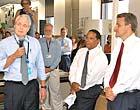
[In the Times picture above, that's Carroll on the left, his successor second from right].

Part of the reason for his departure he says (and I bet it is more than a small part) is pressure from the Chicago-based Tribune Company to squeeze ever higher profits from the wonderfully profitable paper. The Times earns 19% profit, a margin that would make most industries drool. That's not enough to most newspaper executives. I have no idea why. The way they raise margins is to cut back on newsroom expenses, firing reporters, photographers and editors, closing bureaus, folding magazines—in other words, make it harder for the newspaper to do its job and giving readers less reason to buy the paper. Carroll is not the first one to run into this relatively new (20 years) phenomenon.

When we were all much younger, we were at the Inquirer in the 70s. That paper, under John McMillan and later Gene Roberts, was, for a dozen years or so, by far the best newspaper in America. We won awards so regularly, they just ordered champaign on a standby basis, figuring it would not go to waste. I was science writer; Carroll was news editor. One Carroll story tells all: After we had covered the nuclear accident at Three Mile Island, during which Carroll emptied out the newsroom to make sure everything was fully covered (sports writers found themselves on the police beat because the police reporters were at the nuclear plant), I asked him how much the coverage cost the newspaper. His response still makes me smile (now, weep). “I don’t know and I don’t care.” We won the Pulitzer for that as well. I was one of the three lead writers.

Roberts eventually quit the Inquirer when the suits in Miami started demanding cuts in coverage to bring the paper to within its profit goals. It hadn’t always been that way. When the paper was sold to Knight Newspapers by Walter Annenberg, the Knight brothers ran the company and had, by far, the best newspaper chain in the country. They then merged with Ridder, and were taken over by Tony Ridder, known as Darth Vader to his employes. Ridder is far more concerned with the price of the Knight-Ridder stock and pleasing analysts than he is in fulfilling his responsibilities of running a newspaper in a democracy and to his readers. Roberts wasn’t the last. Other Knight-Ridder editors quit over the same issue, including the editor of the San Jose Mercury News, the Ridders' flagship paper. One editor recently quit, suggesting the company has no clue how to run a newspaper. The KR papers now are ghosts of their former selves and we are all long gone.

Carroll went to the Baltimore Sun, bringing with him Bill Marimow, his protégé (two Pulitzers for investigative reporting). The Tribune company bought that paper from the family foundation that owned it for decades. They took Carrroll from Baltimore and brought him to Los Angeles; Marimow took over the Sun. Last year he quit or was fired when he wouldn’t cut the budget to satisfy Chicago. He is now at NPR. Pressures on Carroll in Los Angeles were relentless. One Tribune executive, in the week after the Times won a slew of Pulitzers, was asked how they could be chopping a paper that was so obviously excellent. He responded that USA Today never wins Pulitzers and they have a higher profit margin. Both statements are correct; USA Today is a Gannett paper and Gannett papers are the gold standard for mediocrity in journalism, but the paper finds its way to every hotel room door in the country. I’d have packed at that stage.

By the way, I don’t even like John Carroll very much. He treated a friend of mine and several others unfairly at the newspaper, I thought. As an editor, however, he may very well be the best in the country right now and any company that drives someone like him away, is equally clueless.

[Let me add that winning a Pulitzer is not the defining metric for the quality of a newspaper, but it does say that for one brief shining moment, it rose to the level of excellence, and when a paper wins 15 of them in a few years, attention must be paid.]

The only good news out of this is that the Tribune company agreed to replace Carroll with Dean Baquet, Carroll’s designated heir, but only after Baquet extracted promises about cuts in the budget. He threatened to follow Carroll out the door otherwise. He is a former New York Times reporter and editor, a winner of the Pulitzer for the Chicago Tribune and, by all accounts, a prince.

An old friend, science writer Laurie Garrett, who won a Pulitzer at Newsday, another Tribune paper, was asked after winning the award to make a speech at a stockholders meeting. She told them that newspapers have a special role in a democracy (that’s why they are named in the U.S. Constitution) and if the stockholders don’t want to accept that responsibility they should invest in something else. I would add that if the executives of those companies are unhappy with those responsibilities they ought to try a shoe company or selling life insurance.

Leave the people who care the hell alone. Laurie has since left the business.

By the way, it is no accident that the three best newspapers remaining in America are family owned or dominated, the Washington Post, the New York Times, and the Wall Street Journal.

Here is Editor & Publisher.

UPDATE—CJR Daily, a website at the Columbia Journalism Review (put out by Steve Lovelady, along with Susan Stranahan, both former Inquirer people, has an excellent interview with Carroll, who also worries that corporate ownership doesn't bode well for newspaper quality. You can find it here.

Wednesday, July 20, 2005

Wal-Mart screws women who were screwed the night before


We control every aspect of your life, now shop, dammit
July 20, 2005

In case of Plan B, there is not Wal-Mart—The Evil Empire, more widely known as Wal-Mart, has a surprise for women going to its zillion pharmacies to fill a prescription for Plan B, the “morning after pill.” Sorry—we don’t carry that. Since for many women in the rural areas of the U.S., Wal-Mart is their only pharmacy, they are doubly screwed. Wal-Mart’s excuse is that they are catering to their rural—and supposedly Conservative clientele—but of course that’s who they are harming. They are the only major chain taking that attitude but many others, including RiteAid, allow individual pharmacists to decline to fill those prescriptions if they object on moral grounds, and the legislatures in more than a dozen states are now considering legislation protecting pharmacists who refuse to sell the pill—a pill that is 85% effective in preventing pregnancies. This is typical of the chain, which censors books (try to find Jon Stewart’s “America-the Book” or George Carlin’s “When Will Jesus Bring the Pork Chops.”) Record companies and film companies regularly consult to make sure they are not trampling on the giant’s acute sensitivities. [That’s just one of the reasons I never go there]. But there may be good news ahead. Wal-Mart has just about filled every vacant lot and destroyed just about every town center in the rural U.S., and is now looking to expand into cities, peopled with folks who likely don’t take kindly to stores telling them what they can buy and most particularly what medicines they chose to take. Analysts think the chain will eventually have to moderate its policies. I still won’t shop there. For a good story on same, see AlterNet.

Tuesday, July 19, 2005

Let us hold hands and pray for little Jimmie


Study indicates that prayers for the sick from strangers doesn't work—at least for the stranger. July 19. 2005.

Let us pray. It will make us feel better. You, we’re not so sure about—We’ve all read about it, or even participated in it. Someone is sick, usually a child, and people are asked to pray for the patient. The unspoken assumption is that God will listen and perhaps intervene. Trying to prove religion and faith scientifically is a futile exercise, but every once in a while, someone tries. The most recent, published in Lancet out of North Carolina tests whether those community efforts make any difference. The answer is no. The study, MANTRA II, involved 748 heart patients. Mitchell W. Krucoff, a cardiologist at Duke, took area patients undergoing two heart procedures, and enlisted 12 religious congregations from all faiths around the world to pray for them, giving the prayers the names, ages and descriptions of the disease. They divided the patients into four groups: one had people praying for them, the second received a non-traditional treatment like music, imagery and touch (M.I.T.), the third received both and the fourth, nothing. Toward the end of the test period, the researchers brought in even more congregations to increase the power, I guess. Neither the patients or their doctors knew who was in which group, or more importantly, perhaps, who was being prayed for and who not. The result: virtually nil. It didn’t make much of a difference which group a patient was in. There was a slight advantage in lower stress levels for those receiving M.I.T., and the group receiving both prayer and M.I.T., were slightly less likely to die, but nothing statistically significant. Most religious people were predictably skeptical, mostly claiming—not irrationally—that the powers of faith can’t be studied scientifically. It also doesn’t address whether prayer makes a difference if a patient does the praying directly as opposed to having well-intentioned strangers do it. Krucoff said the slight differences they seemed to find may be a field for further study. [The Lancet article—click above—requires registration. For the WP version, click here.

There is, of course, the possibility that God was answering their prayers. He just said "no."

Sunday, July 17, 2005

Hybrid vs. Hybrid and how the Times gets it wrong


There are hybrid cars and then there are hybrid cars, and mine gets 44 mph on average, but not with a Times reporter in it.
July 17, 2005


Comparing apples and tomatoes and only some of them are green—
Mathew Wald, an excellent reporter at the New York Times, has a story on hybrid cars on the front page this morning. [Click on link] It’s wrong. Wald writes that the new hybrid cars improve performance but don’t save gasoline. It depends on the car; Wald got the technology wrong.

Wald writes that the new Honda hybrids improve performance, especially acceleration, but save little on gasoline. He implies that is a trend, and that the tax saving on using hybrid cars is not doing fuel economy any good. The problem is that there are two separate technologies involved, only one of them is pure hybrid. It isn’t Honda’s.

Honda “hybrids” are not pure hybrids. They take a standard Civic or Accord, add a battery and an electric motor which supplements the gas engine. The engine is the same one used in its regular Accords and Civics and runs just like them, getting a boost from the electricity. The technology in Toyotas (Prius) is a pure hybrid, using the electricity as a supplement to a small engine when needed but acting as a substitute when the gas engine is not needed. Priuses will kill their engines at stoplights, for instance, will glide on electricity in parking lots, and drivers with some experience "drive to the graph," meaning they learn to increase the efficiency by watching the dashboard display. It’s called “stealth mode” because it is silent. Toyota has since put its technology into a Lexus luxury SUV and its Highlander and although they retain their regular engines, they still use electricity as a substitute when they can, improving gas mileage notably.

Wald apparently thinks they are all the same. Not so. To see how the Prius works, go below here.

Friday, July 15, 2005

Spy vs. spy—and how to find one


In the days of the Internet, even the CIA has trouble keeping secrets
July 15, 2005


Want to find out if a spy lives in your neighborhood? Turn on your computer and you need but ask—
It’s hard enough keeping your identity private these days if you are just an average kind of guy. Imagine the difficulty if you are a CIA agent. Just how easy is it to find an agent? Very. David Lazarus, a columnist for the San Francisco Chronicle, has a scary piece on just how easy it is.

Let’s stay that all you know is that a guy named Joseph Wilson has a wife who is a CIA “operative.” You are a journalist (or worse, a terrorist) and you want to find out her name and where she lives. Doesn’t matter how you know—someone from the White House may have told you [we know that couldn’t happen, of course]. Or some sleazy columnist. But nevermind, how do you find her? Lazarus first discovered that Wilson’s full name was Joseph C. Wilson IV and he worked for the State Department not the CIA. Google said he was born in 1949. First, he went to a free website called ZabaSarch.com, which combs public records. After ZabaSearch found too many entries, he refined the search to only those people living in Washington and found Wilson’s home address. Now, to find the wife.

He went to LexisNexis (which is not free but you can pay for individual searches) and confirmed that the Wilson at that address had a spouse, “Valerie E.” Then he searched by that name and found “Former name: Plame, Valerie E.” According to Lazarus, she was using her maiden name as part of her cover: an energy industry analyst for Brewster Jennings & Associates, which is actually a CIA front. [All this is now public knowledge, by the way and the company no longer exists—at least on the web]. This all took less than a half-hour. Then he went to Google’s map service and got a high-resolution satellite picture of the Wilson home. Google even provided directions. Nice digs.

Lazarus correctly states that while this is all great fun, it also is illustrative of the danger Valerie Plame was put into by the great patriots in the Bush administration when they outed her to get back at her husband—and incidentally the wonderful journalism Robert Novak performed in helping them. Anne Coulter, the queen of the village idiot wing of the Conservative movement, wrote a book accusing liberals of being traitors. What do you call a guy who writes a column exposing a CIA agent—or a White House official who gives him that name?

Thursday, July 14, 2005

Sex and plankton--read all about it


He's back! And the march of science and medical news slithers hither. July 14, 2006


I swim all the way over here and I can’t find a thing to eat--Plankton, the lovely little stuff that constitutes the fast food of the oceans, is disappearing along the Pacific coast and the consequences could be most unpleasant, particularly if you are a fish or a seabird. [If you are a fish or seabird and are reading this blog, please phone in]. But seriously, folks: scientists report that oceanic plankton has largely disappeared off the coast of northern California, Oregon and Washington. No one has any idea why. The mechanics involves the updwelling, the surge of very cold, nutrient-rich water that supports the organisms from the depths of the sea, which is a veritable smorgasbord for fish and wildlife, the basis for the marine food chain. Everything eats plankton, even baleen whales. When it disappears, the fish and mammals move elsewhere. This can have a devastating effect on sea birds, which eat the fish, and that’s what’s happening now. Bill Sydeman, director of marine ecology for the Point Reyes Bird Observatory said nesting sea birds in the Farallon Islands have lost population in unprecedented number, including such rare species as Cassin’s auklets [see illustration]. Cormorants also are dwindling. "Something big is going on out there," says Julia Parrish at the University of Washington. "I'm left with no obvious smoking gun, but birds are a good signal because they feed high up on the food chain." It isn’t El Niño; but it could be the result of climate warming and it could be long-term. Coastal ocean temperatures are up 2 to 5 degrees above normal, again a clue that the updwelling isn't.


Look, being a virgin is hard enough, now you have to read journals?--If you want to see a good example of how to politicize science, take a look at Jordan Ellenberg’s piece in Slate, which takes on the Heritage Foundation report on virginity. We reported on it initially here. Researchers from Yale and Columbia in March published a paper in the Journal of Adolescent Health, reporting that young people who pledged to stay out each other’s bed [do they do it in the back seats of cars any more?] until they are married are just as likely to have sexually transmitted diseases as the ones that don’t. The rise of virginity pledges comes from the socially conservative who oppose sex education, among other things. The report said essentially that it didn’t work. Last month, two researchers at the Heritage Foundation delivered two session papers and a press release [not an article in a peer-reviewed journal] taking after the first study. The Heritage Foundation is a conservative think-tank and was stung by the first report. Both sides used the same longitudinal study. The authors of both studies agree that kids who take the pledge wait longer to have sex than those who don’t but it may be self-selecting: they may have a predisposition to wait and therefore it is easier to make such a promise. What they disagree on is the statistical analysis, and what constitutes statistical significance, the famous p-value (the probability of obtaining the observed result if the null-hypothesis were true.) Oddly, both camps fail the test. Read it; it’s a rare look at the use of statistics in social science and how complicated things can get, especially if you have an agenda.


But someone who obviously did not make such a pledge could use a hand here--A Nigerian tribal chief has a problem all us guys can relate to. He has a harem. The harem apparently is too large for him. He can’t service it properly. You know how it is--you get a couple dozen women in your harem and the next thing they know they want to get laid regularly and as a guy gets a bit older, well, you know. So he puts in an order to an Israeli company that makes a prescription drug for erectile dysfunction that is a lot cheaper than Viagra and allied substances. Trima is the only company in the world making the non-patented drug Tesopalmed Forte Cum Yohimbine [I’m not making any of this up, you know]. It costs about 1/40th of what Viagra, Cialis and Levitra costs and presumably actually works for mild cases of dysfunction. How mild this guy’s dysfunction is could be a function of how many wives he has in his harem. The Jerusalem Post [registration required], which reported this poor man’s plight, doesn’t say, and doesn’t identify him. The drug comes from the bark of the African yohimbine tree. How did the chief know about it? Well, the company’s export agent in Nigeria used it to service his harem, was very pleased with the results and word got around. The rest is history.

Tuesday, July 05, 2005

If you pull and I push we can get nowhere

EPA and Congress go in two different directions simultaneously.
July 5, 2005.


images What we have here is more than a failure to communicate-Just as Congress is about to strengthen the rules on the use of human test subjects, including tests of pesticides, the Environmental Protection Agency’s top brass may be loosening the rules. The move, the Baltimore Sun reports, has triggered a revolt by senior scientists, physicians and even its lawyers--and you know something is afoot when lawyers get involved on the side of the angels. The Sun obtained an internal memo predicting that the rules change might “greatly weaken existing protections outlined in the EPA Common Rule for the Protection of Human Subjects.” While EPA scientists do some tests using human subjects, most of the research is outsourced to university and industry labs--including pesticide manufacturers. The rules cover all the work, that done in-house, and those done under contract. The EPA doesn’t agree, saying the rules changes--promised next month--are based on science and ethical considerations and nothing is yet set in stone. Meanwhile, a series of bills in now going through Congress that would ban EPA or its contractors from doing any human experimentation. The “Common Rules” mentioned in the memo, are rules adopted by several government agencies; the origin of which goes back to the revulsion of scientific experiments performed by the Nazis in World War 2. Critics say the new rules either ignore or wrongly interpret that standard.

Monday, July 04, 2005

The Value of Stuff--$330 million of it


The stuff of comets. July 4, 2005


Whomp!--
Everyone once in a while NASA does something remarkable, and in a billiard shot of classic proportions, they did it Saturday, hitting a comet in mid-space with an 820-pound object. The result was a huge and glorious explosion of stuff.

Now stuff is important because when you see stuff, you can analyze stuff and then tell what the stuff is that’s in a comet, which we didn’t know before. Traveling at 23,000 m.p.h., the copper impactor hit the surface of Comet Tempel 1 and blew out stuff, giving scientists all the data they can handle. The stunt was equated with hitting a bullet with another bullet and watching from a third, but they pulled it off, spending only $333 million [no complaint from me]. They hoped to impact [and that, ladies and gentlemen, is the correct use of the verb] a crater about the size of a football stadium so they can peak inside Tempel 1. Whether they did so or not was not immediately clear because, well, all that stuff flying out. The best pictures are yet to come. More important, the mother ship, the one tailing along and taking pictures, is doing just fine, sailing along 300 miles from the nucleus.

The shape of the crater will tell more about the consistency of the comet, how firmly it is held together. The venture should also tell us something about what comets are made of. Why do we need to know this? It is believed that comets are made of the remnants of the stuff that created the solar system. Stuff is good.

The best source is NASA, here.

Friday, July 01, 2005

Five Questions on the Plame Case--UPDATED 7.5.05

Editor sells out his reporter and a happy Fourth of July to all.
July 1, 2005


Going back in Time--I have five questions to raise about the decision by Time Magazine to produce the notes of its reporter, Matthew Cooper, in court rather than fight.

1. How can any reporter for Time magazine now give assurances to a potential confidential source that he will protect that confidentiality knowing he has a eunuch for an editor? As one critic said, Time’s days as an investigative journal are over. It is a high-gloss People.

2. Why would any whistle-blower with a story to tell that could be important to the running of our democracy take it to a Time magazine reporter when he can go to the New York Times and be assured they will protect him?

3. Why would a court order journalists to declare the identity of their source when the special prosecutor says he already knows who it is?

4. Why is the Washington press court not circling around Robert Novak, the man who triggered all of this and has refused to discuss it like the sharks they can sometimes be? Too much “old boy” here? Novak, accurately described by Jon Stewart as the “scum bag of democracy,” is still showing up on television ranting about the ethics and morality of others. It was he who published the name of the CIA agent and it is others who are threatened with jail, including Judith Miller who never actually wrote a story. Clearly one of two things has happened: a) he squealed to the grand jury like the scum bag he is, or b) he took the Fifth Amendment. Since the law reads that publishing the name is not against the law--only revealing it is--it is probably the former. He now claims he was not responsible for the other reporters being threatened with jail, but of course had he not printed the name, they wouldn’t be.

5. Anybody but me notice that it was the publication owned by media conglomerate that capitulated and the one owned by a family stood by its man (or woman, in this case)? As a friend, Laurie Garrett, once told stockholders in the old Times Mirror Company, if you don't want the responsibility of owning a press in a democracy, go invest in a shoe company and leave us the hell alone.

Just a small rant. Have a great July 4. Just remember that we are the nation that lectures others on the importance of a free press. Now think of Matthew Cooper and Judith Miller and the guys who threatened them and thee editor who sold them.

For a serious discussion of same, try Steve Lovelady's piece in Columbia Journalism Review. Lovelady was the managing editor (I think that was his title) at the Philadelphia Inquirer when I was there. Is is right on the money. Go here.

UPDATE-- The answer to number three may be that the special prosecutor wants to charge perjury and perjury requires two witnesses. If someone went before the grand jury and announced that he did not leak the agent's name and the prosecutor can find two witnesses that say he did (say, Novak and one other), he has a case. It also is reported that Newsweek and several other sources also know who the leaker was: Karl Rove. That would be interesting.

UPDATE--On Tuesday, the special prosecutor said he would still need Cooper's testimony even though the magazine turned over Cooper's notes (if they are like my notes, they are unintelligible, even to me). So selling out his reported didn't do the editor of Time much good, did it? And the prosecutor said the reporters shouldn't do home confinement but should be sent to the slammer.