Wednesday, April 27, 2005

Radio days, the invention of a word and power to the people--UPDATED 5.5.05

Podcasting may be the savior of commercial radio and rescue popular music.
April 27. 2005

images
There is no more irrelevant form of media than commercial radio. The AM dials have long ago been taken over by wingnut performers disguised as political commentators, and a half-dozen corporations, which get their programming lists from focus groups, control the FM dial. Essentially, that leaves us with public radio. Part of the problem, of course is the sad state of popular music at this moment, and the scandal of rap and hip-hop, which aren’t music. What’s left of the audience is escaping to iPods or free-form satellite radio, which allow you to do your own programming—commercial free.

A San Francisco radio station is starting an experiment that could revolutionize radio. It is adopting its audience’s iPods as its programmer, in a form of communication called "podcasting." [Note the birth of a new word, derived from Apple’s ubiquitous and magical devices]. No one knows if it will work, but what have they got to lose?

According to Wired.com, Infinity Broadcasting, one of those aforementioned corporations (183 stations, one as boring as the next) is switching it’s KYCY-AM to listener-submitted content. Just what that content will be is a mystery to everyone, including, one supposes, Infinity. The new call letters will be KYOURadio. Transmission will be by podcasting.

A podcast is anything collected on an iPod or another MP-3 player that is then transmitted, usually via the Internet, to someone else’s iPod. The content can be anything from music to discussions to the sound of crashing waves. They are the latest new thing. What Infinity is proposing is that its listeners send their podcasts to the station by its website, and if the podcasts are interesting and don’t violate FCC rules (keep in mind, this is San Francisco so the standards are bit different) they’ll play them—whatever they are. If the podcasts include copyrighted music (like the stuff you downloaded from iTunes), the station will pay the fees. It’s not clear what they expect to come in, and what the station will sound like, although there will be commercials. This is commercial radio, after all. Many of the submissions could be bands and musicians who cannot break into the business, and this may be their best way to get heard, just as it was when FM radio was in its glory days in the 60s and 70s—before corporations like Infinity screwed it up.

“I’m excited,” said Infinity vice president Joel Hollander. “We’re creating a new way to let a lot of people participate personally in radio—sharing their feelings on music, news, politics, whatever matters to them. I also think this is going to be a really interesting way to develop new talent.” Again, this being San Francisco, it is not likely to be dull. It has to be better than phone-in radio.

It’s another case of the Internet giving power to the people in ways no one anticipated—like blogging, actually.

According to Robert MacMillan in the Washington Post, this podcasting experiment is part of a move by station owners to get relevant again. Stations are adopting a programming format called Jack, which permits a random kind of music list, something like what you get from the Party Shuffle mode on the iPod. The result is one song coming right after another in an unstructured manner that would drive the programming chiefs of most radio stations to apoplexy. The origin of this programming apparently was a station called BOB-FM in Winnepeg, Manitoba, which begs the question why it is not called BOB. [It's actually named for an east coast DJ] A station in Denver was the first U.S. station to play JACK or BOB, and a half dozen others have followed. On May 5, it struck here in Baltimore, when WQSR became JACK-102, fired all its hands, and suddenly went freeform. They have a play list of about 1,200, instead of the usual 400, which will hardly impress an iPod owner.

Over at Forbes.com, Sam Whitmore reports a Pew study showing that 22 million Americans own MP-3 players (presumably, mostly iPods), a number he thinks is too high, but I don't. Apple sold 5 million in the last quarter. And podcasting is becoming as ubiquitous. Paris Hilton [if you are expecting a link, forget it] will podcast to promote her movie; the SciFi channel runs podcasters by the executive producer of Battlestar Galactica to comment on each episode; former vice presidential candidate John Edwards is keeping in the public eye with his own podcasts, and record companies are tying to figure out how to handle the legalities of podcasting, an entirely new legal conundrum, with the Grateful Dead and all the free music being a particular chore.

The key quote: “Madison Avenue realizes there is an entire generation out there that doesn’t listen to the radio.” Actually, more than one.

Poynter blog

Monday, April 25, 2005

Scandal under the dome

Another scandal in journalism as a well-known technology writer gets in trouble
April 25, 2005

Dome

Technology Review, the well-respected magazine associated with the Massachusetts Institute of Technology, has its own journalism scandal brewing. A freelance technology writer, Michelle Delio, a regular contributor to the magazine, has had all of her stories pulled when an outside investigation was unable to corroborate most of them.

Another of her clients, Wired Magazine, has launched similar investigations and a third is reediting a story it already ran.

Of the 10 stories by Delio published by Tech Review, Susan Rasky, a professor of journalism at the University of California at Berkeley and her graduate students, were able to verify three. Rasky was unable to back up the sourcing and accuracy of the other seven and Tech Review has pulled all of them from its website with a note stating why. Jason Pontin, the magazine's editor, said it was possible Delio was just a sloppy note-taker or that some of her sources lied to her, but "I cannot verify the sources in seven of the 10 stories she's written for us, therefore do not stand by them."

Delio, 37, a New York-based writer, admitted making mistakes and said she should have kept her notes to help verify sources. But she insisted that she fabricated nothing and declined to reveal her source for the HP stories.

"I certainly didn't make up sources," she said. "Leaving aside the huge issues of ethics, you're always going to get caught. Possibly I was lax in record keeping, but it doesn't mean people don't exist.

"(Stephen) Glass and (Jayson) Blair were fabricating facts, fabricating major sources, minor sources," she continued. "You're just not going to find that in my work." Glass fabricated stories as a staff writer for the New Republic. Blair did the same at the New York Times.

The three stories Rasky was able to verify were: "Augmented Reality," published last February; "The Snow Man" published the week before, and "Encrypt This," published in the previous November. Two stories, both about the removal of Carly Florina as CEO of Hewlett-Packard, have not been verified because they relied on unnamed sources and identification was too sketchy to enable Rasky to find them. One source was identified as Hungarian with the initials G.S, who one would assume would be easy to find, but no one apparently could. It was HP that triggered the investigation about one of those stories. (They weren't aware of the other.) Delio promised to provide more information but did not do so until last week. In the case of another story, "The Future Shock," one source quoted in the story said he never talked to her. Sources in another story said they met with her but talked about something other than what she wrote about.

Over at Wired News, management hired Adam Penenberg, the former editor of the New Republic who caught Stephen Glass faking stories at that publication, to do the same investigation on Delio. (He was played by Steve Zahn in the film, Shattered Glass.) He has no results yet.

Infoworld magazine revised one of her stories, removing quotes they could not verify.

Technology Review seems an unlikely place to find journalism fraud, but someone pointed out that the stories involved were business stories, not technology, and perhaps they were just out of their league.

This is of course more bad news for journalism, but the silver lining in this dark cloud is that these scalawags have been caught, the stories retracted and apologies made. The system is, to some extent at least, self-corrrecting, which is a good thing. That it happens at all is appalling.

Life is a cabaret, old chum--UPDATED

Only a cabaret
April 25, 2005

life
Like a lot of lazy people, I have a standing joke that I have is my list of people who died while jogging. It's not actually a list, just recollections, starting, of course with James Fixx, the famous marathon runner. If he was sitting on a couch, drinking beer and watching a baseball game, he would have lived longer. He wasn't really a great example, to tell the truth; he was very sick before he started running that day, had every reason to know he was in trouble yet went and ran and died anyhow. Nonetheless, the list--if there was one--is long and honorable, including the former governor of Florida who fell off his treadmill, and Jack Kelly, the brother of Grace Kelly, an Olympic athlete who would scull up the Schuylkill River in the morning and then go running. He dropped dead in front of my office. Then, of course, there was Doug Adams, the wonderful creator of the Hitchhiker books. He died at 49 at a health spa. The saddest story I know was a law professor at Stanford, John Kaplan, one of America's great experts on Constitutional law and a splendid man. He ran marathons, ate nothing that could clog anything under any circumstances, and while he was honing his heart to that of a lion, a tumor was growing in his brain. A friend described him as having the fastest mind he had ever seen. Same brain. He was president of the faculty senate and his colleagues, in respect, let him continue even though he was rapidly becoming incoherent. It was excruciating to witness. There is not a rule that man broke and he was still dead before the age of 50. He jogged until almost the end.

All this rumination is a triggered by a piece by Gina Kolata [$] had in the New York Times a week ago, pointing out that only Americans think they can battle aging and prolong life by their behavior. Most Europeans and Asians know better. Europeans don't read diet books and think our passion for them amusing. This battle with mortality is a peculiarly American trait, part of our charm, I guess. It is not just that Europeans think out fat-battling diets are ridiculous (and they guess, correctly, that none of them actually work for most people) but it is philosophical. Life, they know, is a crap shoot. Your longevity is largely determined by who you are and the genes you got, and then, what you do with them. And when your time comes, your time comes and that too is part of life. What part religion plays in this, I cannot tell, but I'm not sure that it does. We share the same religions they do.

As I approach the age at which my father died--of his third heart attack--I understand this. He would not have died at 67 if he did not smoke for many years and had access to the same medicines I do. My blood pressure is under control (Atenolol) and my cholesterol is at a lovely level, thank you (Pravacol). I have had nothing, praise be, even vaguely resembling a heart attack and the heart disease I do have is minimal. It's being watched and when it is necessary to do something drastic about it we will. Indeed, had my father been around for statins he might have gone on for many more years. Even popping aspirin might have made a difference, but no one knew that then. He lived too early. Bad luck.

I am convinced, as Ms. Kolata wrote, that while you can alter the odds somewhat, it is mostly genetic and karma that determines how old we live. Smoking obviously alters the odds. Working with asbestos radically shifts those odds. So does skiing in avalanche country. Devouring Big Macs and fries clearly is not going to do you any good, and if nothing else, will make you fat. Eating well, exercising and not going bungee jumping, also alters probability, but that's all it does. Mostly it is your genes and luck. I have an uncle who still works three days a week at the age of 93, looks 10 years younger, and except for a few odds and ends, has a fully functioning mind and body. His mother made it to 92, his aunt to 102, his sister (my mother) to 82, and his brother is doing fine in his late 70s. Another brother died of liver cancer in his 40s, and no one can guess why. I'm counting on those genes and hoping to avoid his brother's bad luck.

The problem we all run into (especially medical writers) is that scientists do studies and show that in the aggregate, the odds of living longer are improved by eating carrots, blueberries and kale, and we write stories to that effect (me too). People who exercise live longer than people who don't. In the aggregate. (That people who exercise may feel better than people who don't is not an issue. I concede the point). To an individual, it really doesn't make a hell of a difference. Cancer is a disease of age and every day in every place, I think, some cell is misbehaving. Almost all of the time, our bodies stomp on it and we never notice. And then sometimes, it doesn't. You are either programmed to have heart disease or you are not, and if you are, there are medicines. Indeed, death by heart attack is now a shrinking component of mortality tables thanks to aspirin and statins. I am convinced that only thing switching to a fat-free diet will accomplish is to take flavor out of my meals.

I would advise that we reconsider stories like that. I would, except that Americans still like to read them; editors, therefore like to print them and pay writers to write them, and writers....well, it's hard enough to make a living writing without standing on a useless principle. Maybe we should just not take them too seriously.

Thursday, April 21, 2005

If Plan A fails and they won't let you have Plan B...

Canada approves morning-after-pill without fuss.
April 21, 2005
imagesCanada, the eminently sensible country north of the border has, without a great deal of publicity or turmoil, approved the sale of Levonorgestrel 0.75 mg for sale over-the-counter. That’s Plan B, the emergency contraceptive being blocked in the U.S. by the wingnuts who would rather have a woman have a child she doesn’t want or shouldn’t have than not get pregnant at all. Health Minister Ujjal Dosanjh [really] announced that "women who need this product must have access to it very quickly or it will not be effective. Allowing the product to be sold without a prescription will ensure that it is available when needed." Plan B [absolutely love that name] can prevent pregnancy up to three days after unprotected sex, but works best if taken within 24 hours. Health Canada said that it extensively reviewed the clinical evidence and safety data before making the decision. The decision was not a big deal up there. Three provinces, Quebec, British Columbia and Saskatchewan, already permit sales in drug stores without prescription. You have to ask the pharmacist. The Toronto Globe & Mail, arguably the premier newspaper in the country, put the story on B-16. A similar decision in the U.S. would make every front page. The U.S. Food and Drug Administration (FDA) has been delaying its decision on Barr Pharmaceuticals’ request for similar approval despite a January deadline, claiming it needs to study the issue of the use by girls 15 years old or younger, but is actually afraid to get religious fundamentalists upset. Health Canada said its investigation led them to believe there is no issue. "No outstanding concerns on its safety in younger teens has been identified, the agency said. “there is no reason to delay timely access to other women." Barr asked for permission to sell Plan B over-the-counter to females over 16 and by prescription for the younger ones. Religious conservatives claim that the ability to take Plan B would lead to an increase in risky sexual activity by young women and more sexually transmitted diseases. On the other hand, not permitting it would lead to more abortions. Go figure. Democratic senators are holding up the nomination of the new FDA commissioner, Lester Crawford because of the delay. Several states, including California, are formulating plans to circumvent FDA obstruction, kind of a Plan B for Plan B. In the words of Health Canada: "A number of European countries and several U.S. states have already granted access to emergency contraceptives via pharmacist-controlled sales. In Canada, behind-the-counter status would give timely access and professional advice." Heaven forbid. Canada is now the 34th country to approve the pill.

Oh yes. Canada also became the first country to approve a pain killer for multiple sclerosis--based on the active ingredient in marijuana.

Wednesday, April 20, 2005

Make sure there is chicken fat in that chopped liver

Medical study adds to confusion about obesity and what else is new?
April 20, 2005

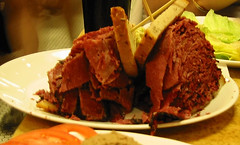
To repeat myself: the three things the medical community knows almost nothing about are sex, lower back pain and nutrition. Today we discuss the third. A study reported in JAMA says that obesity is less of a killer than first thought, only 112,000 Americans a year instead of the 400,000 previously reported. Those affected were the really, really fat (say a 5-foot-4 inch woman weighing 204 pounds or so). Being underweight killed 34,000 Americans. The researchers, at the Centers for Disease Control and the National Cancer Institute used the body mass index in their study. [An aside: has anyone else noticed that the cancer institute home page has nothing but smiling people on it?] The reaction in the medical community was mixed and it was reflected in the stories published in newspapers, with Gina Kolata in the New York Times being considerably less skeptical than Rosie Mestel in the Los Angeles Times. Mestel quoted someone from the Harvard School of Public Health calling the study “really naïve, deeply flawed and seriously misleading,” which is not a quote you see very often in news stories about medical findings--and should. But we shouldn't dismiss the report out of hand. Those of us who are, shall we say, a tad round around the waist, in other words, just a bit overweight, tend to live longer, as if the extra weight afforded some protection, according to the study. We suffered 86,000 fewer deaths than those whose weight was in the “normal” range. Right on! I wonder how much of the bad press fat folk gets is actually aesthetic? And the increase in obesity does not require a government research contract to find. Anyone paying attention has noticed in the last 10 years a great increase in really overweight people, particularly Americans. Go to any mall, any airport, any sporting event. Walk down any street in the world outside of the U.S. and you often can spot Americans, mostly by their girth. You might confuse them with an occasional German, but thanks to the terrible things we eat (visit Burger King and order an Enormous Omelette Sandwich--their trademark--and gulp down 730 calories and 47 grams of fat, which ought to qualify you for a Darwin Award). All this reinforces my opinion that none of those guys have any clue what they are talking about, and in honor of the report I am about to go out and get myself a chopped liver (heavy on the schmaltz) sandwich on rye with tomato at Edmart for lunch, which is to die for. OK. Bad choice of words! [And yes, the picture above is a pastrami sandwich at New York's Carnegie Delicatessen, the gold standard of self-indulgence]

For more, try Daily Kos here.

Monday, April 18, 2005

Death of a hero--UPDATED

Marla Ruzicka 1977-2005
April 18, 2005

This has nothing to do with medicine or science but a hero died Saturday. Her name was Marla Ruzicka. She was 28 and she took her opposition to the war as a moral imperative. Unlike the blathering bobbleheads on cable television and in Congress, she went Afghanistan and Iraq, surely the most dangerous places in the world, and set up an organization, the Campaign for Innocent Victims of Conflict (CIVIC), to help the innocent civilian casualties of the war, the very people we don’t read about and the Bush administration choses to ignore. She had no sponsorship and was on her own. Back in the U.S., she convinced Congress to approve $10 million in aid to the Afghans and $20 million for Iraq, the same people who spent $80 million investigating Bill Clinton’s sex life. She was described as beautiful, scatterbrained, charming, relentless and apparently fearless, and had been doing this kind of stuff all over the world since she was 15. Several years ago, according to the San Francisco Chronicle, she mooned President Bush. She had “Public Power Now” written on her underpants. Bush looked at her and said, “cute.” Her statistics on casualties on Iraq are considered as definitive as any, and her works are used as a resource by almost every journalist who went to Iraq, most of whom knew her. She crashed on their couches and threw parties to cheer them up. Perpetually broke, she sold blackmarket beer to raise money for the medical bills for innocent victims and rolled over American diplomats who failed to take her seriously. When U.S. officials said they didn't know how many Iraqis were killed accidentally by the invasion, she told them. Even generals learned to take her seriously, especially when she organized a mass of Afghan families to demonstrate for compensation. A number of reporters wrote appreciations for her, including Pamela Constable at the Washington Post, Ivan Watson on NPR, and Doug Smith of the Los Angeles Times. Also see Jennifer Abrahamson's piece in Slate. They were friends. Marla helped thousands of people who had no one else to help them and risked her life for them daily. She was killed Saturday along with her drive and another Iraqi on her way to help an injured child. A bomb exploded near her convoy on the infamous Baghdad airport road. It apparently wasn’t anything personal; the “insurgents” just saw a convoy and blew up the bomb. I wonder if President Bush, who cut short a vacation to intervene on behalf of a brain damaged woman in a Florida hospital, will bother to say anything.

One doesn’t know really what to say to her parents, except send them your condolences and admiration. Or:

Donations to CIVIC can be made in her memory to CIVIC, P.O. Box 1189, Lakeport, CA, 95453.

Damn!

The decline of western civilization, part 2

Please take your tongue out of my ear, darling, the phone just rang.
April 18, 2005

A study by the advertising agency, BBDO Worldwide, has found that 14 percent of the world’s cell phone users will stop in the middle of sex to answer the phone or their Blackberrys. The Germans and the Spanish were the most likely to interrupt sex, 22 percent. The Italians (of course!) were the least inclined to answer the phone, 7 percent. Americans rolled over 15 percent of the time, cell phone interruptus. As reported in AdAge.com [free subscription], the report came from “Wireless Works: Exploring New Brand Connections,” a study designed to show how people use wireless communications. The motive was to see if there was room for advertising on cell phones, which is just what we need. People apparently are reluctant not to answer lest the call be important and besides, getting a cell phone might impress your partner, according to Christina Hannis, head of BBDO Europe. In fact more than 52 percent of respondents used their cell phones to flirt. Almost half the respondents believed their cell phone says as much about them as the car they drive. Answering the phone during sex certainly does. [If my wife is reading this, I was much younger then, and besides it was always my mother.]

Jonathan Beard points out another phenomenon: men who stand at the urinal talking on the phone. He finds that odd. OK, a survey: how many of you have taken a business call whilst sitting on the toilet? I thought so.

Friday, April 15, 2005

God, the Big Bang and government scientists

What happens when science and the Bible seem to agree?
April 15, 2005

Every year, on the Saturday after the Jewish holiday of Simchas Torah, an astrophysicist from the University of California Santa Cruz campus would come to synagogue just outside of town, and deliver the dvar Torah, the dissertation of that week’s reading from the Torah (the first five books of the Bible). The reading was Bresheet, the beginning of the first chapter of Genesis, wherein God creates the universe. The astrophysicist was appropriate because the similarities between the description in Genesis and the current cosmology, the Big Bang, are spookily similar, even though the former was written more than 2,000 years ago. If you make allowance for metaphor (the word “day” does not mean day but a discrete block of time), there is not only no conflict, but the two seem in many ways simply different lenses on the same story. One has a supernatural origin, the other doesn't. Having an astrophysicist do the dvar Torah, as an astrophysicist (he was Jewish), always amused the congregation. But he was always good at it, he never made too fine a point of specifics so he did not try to define things like string theory. He wasn’t representing anyone but himself and we loved having him join us. How things have changed.
Now, with the new emerging theocracy in America, scientists need to be really careful about that kind of stuff. One man who demonstrated that is Raymond Orbach, director of the office of science at the Energy Department. At a brown bag lunch someplace (not sure exactly where) Dr. Orbach did something like what the Santa Cruz astrophysicist did, except, he of course made a Powerpoint presentation. (My idea of hell, by the way, is spending an eternity watching Powerpoint presentations). Titled “Genesis, Science and the Beginning of Time,” Dr. Orbach also pointed out the striking similarities between Genesis and the Big Bang. His problem, of course, is that he works for the government and the Powerpoint images were government issue. It might have even been at a government office. I don’t now. You can find it here, a pdf file. Whether he should have done so or not, is now the topic of a commentary battle on Technology Review’s blog. [Thanks to Jonathan Beard for point me to this]. By this afternoon, there were 38 comments posted about the presentation, with most of them unhappy about the talk. The fact he quoted President Bush, was noted by many. The issue, however, goes back to the ancient battle of whether you can be a scientist and believer. Clearly the astrophysicist at Santa Cruz didn’t think there was a problem, but many of the correspondents on the Technology Review blog did.
Orbach takes science back to its limits, something like string theory and the first 10^-44 seconds, but in going back further then seems determined to inject religion into the discussion by quoting Genesis and by quoting others who invoke God as part of the process that explains the beginning of time. Not exactly what you would expect of a man of science—a science that has succeeded in going back further and further in time towards the Big Bang, and which shows no signs of suddenly stopping or of needing to invoke God at any point.

Is Orbach pandering to the religious right or devaluing science as is already underway in the Administration? In any case, I don’t think it’s appropriate for a man of his position.
Some writers were fervent atheists, which they presume to be the proper mindset for a good scientist. And others thought it was fine, except that it seems to be part of a growing religiosity that ought to be a concern to everyone. (Religiosity and being religious are not necessarily the same thing.) Some were merely amused.
There are people who do not understand the inherent separation of religion and science. I am not as well versed on the subject as the experts, but the short version is that religion can accept science as a study of God's universe and science cannot comment about God. The statement of religions position about science is pretty clear and historically supported (even, by some historians accounts, in the case of Galileo). The statement about science's view of religion is less obvious. Science is the study of the world around us. It is not based on opinion but on evidence. Ideas in science change as this evidence comes to the scientific society (we like to think). By the nature of what God is (supernatural), we cannot gather evidence about him/her. Therefore science cannot, and probably doesn't want to, comment on God. Science cannot prove or disprove God and as all the scientists reading this know, you can only disprove a hypothesis.

P.S. Scientists know that God is separate from science. People who claim science disproves God really do not understand either. They state opinion as fact without evidence or legitimate support. Such statements are very unscientific.
It is an interesting and ancient dispute, made more interesting by the times we live in. Would Dr. Orbach felt comfortable making such a presentation before the era of George Bush and the rise of fundamentalism?

And by the way, the similarities in versions of the creation get better if you use the Hebrew version (and its translations) rather than the Christian versions, which are based on the Greek and contain numerous errors. For one thing, the tense used to describe creation is different in the Hebrew. From the Jewish Publication Society Translation:
When God began to create heaven and earth, the earth being unformed and void, with darkness over the surface of the deep and a wind from God sweeping over the water--God said “Let there be light”; and there was light.”
Bang.

Thursday, April 14, 2005

Remember that package we sent you last week?--UPDATED

Wrong virus is shipped to labs around the world and is hopefully destroyed before it gets loose...again

April 14, 2005
Add to the list of good intentions gone awry: Periodically, the College of American Pathologists (CAP) sends a package to labs around the world containing unidentified pathogens. The recipients are supposed to test the contents and report back. That’s how the college tests the labs; if you identified it correctly, you are doing fine. If you don’t, your lab needs attention. The CAP kits are sent out from a private contractor, Meridian Bioscience in Cincinnati. Somebody at Meridian goofed and sent out a package containing one of history’s most deadly influenza vaccines. No one is supposed to get hurt doing these tests and in well-run labs, the pathogens do not get loose. But, they did, by accident at the Canadian National Microbiology lab in Winnipeg, Saskatchewan, and it contaminated a sample in a lab. An alert technician discovered the contamination and the lab, one of Canada’s best, had no trouble identifying it as the flu that caused the Asian flu pandemic in 1957 that killed millions around the world, an H2N2 virus. The virus evolved into another type in a year, as flu viruses do very well, and we now get sick from something else. What makes this serious is twofold: no one born after 1958 has any immunity to this potentially deadly virus, and the virus is not used in vaccines since it no longer poses a threat. If the virus could escape from a lab as good as the one in Winnipeg, it could get away from other labs. All that has to happen is that it infects one lab worker, who goes home, goes shopping, gets on a plane or otherwise insures transportation and contagion. At the request of the World Health Organization, labs around the world are now busy destroying their samples, autoclaving them to cinder. So far, there have been no reports of an escape. Interestingly, Canada and most other countries classify the virus as Type 3, meaning it requires the very high security precautions. In the U.S., it is only Type 2. That classification is now being reassessed. And, incidentally, the 1957 pandemic began with birds in Asia, just as one seems to be forming now.

UPDATE--The World Health Organization says that all of the virus samples have now been destroyed.

Blogged elsewhere.

Wednesday, April 13, 2005

The decline of western civilization, part one UPDATED

Just sitting here in the living room knocking off kittens.
April 13, 2005
There are probably no crazier groups of people in America than the gun fanatics and cat lovers. The gun fanatics idolize their weapons and worship them in a way that comes close to religious idolatry. The weapons serve no use except to kill things, which, unless you are hunting for food, is not admirable. The cat people romanticize their pets, going great lengths to describe how smart cats are and how wonderful are their personalities. In fact, cats are as dumb as doorknobs and only seem to have a personality to people who don’t. It was only a matter of time before the two groups would apparently clash and now they have. It’s not clear who will win. In Wisconsin, one of the saner of the states, the Conservation Congress, an advisory group to the Department of Natural Resources, took votes around the state and the results--if they follow through--would remove the protected status of feral cats. That means if a little pussy ran across your front yard and did not have a collar, you could pop the little darling with your Magnum. The vote in every county was in favor of shooting the cats. The Congress now has to make a recommendation to the DNR and it is the DNR that decides what to do about the cats. Now it is perfectly true that in some places in the world (Australia comes to mind) feral cats are a serious threat to the environment and killing them would be a blessing to all the birds and other creatures that are part of the feline food chain. The cats aren’t natural to the wild but were pets that some cat lovers couldn't or wouldn't take responsibility for. In Wisconsin, they kill millions of song birds. Several people appalled at the idea have discovered it is not quite as weird as it sounds. Both Minnesota and South Dakota already permit killing feral cats, and we all know how sensible Minnesotans are. I married one. Rules haven’t been talked about yet. For instance, what about collateral damage when you try to shoot a bothersome feline in your yard? Like if you hit the 8-year-old girl across the street? The good news is that any rule would eventually require an act of the legislature, which apparently includes some cat people.

But hunters, take note; all is not over. You can may be able sit at home at your computer and still kill something. A Texas company (where else!) is considering letting people use a computer mouse to operate a remote-controlled rifle to hunt deer, antelope and pigs in a hunting preserve. (I am not making this up). It’s called Live-Shot. For a small fee, $150, you take control of a rifle and camera and aim at the animals wandering around in the park. Click and shoot. (One presumes you have broadband. The only thing you could hit with a modem and AOL would have to be sound asleep). The Texans already have the rig, a $10,000 device that contains a camera and a .22 rifle. The originator of this idea, John Underwood, says one use would be to permit handicapped people, who would have trouble getting out in the wild, kill something. [NPR Audio]My suggestion is that he sets this up in, say, Madison, Wisconsin so we can have pictures of handicapped people shooting cats from their living room.

UPDATE: But all is not lost. According to the Los Angeles Times, lawmakers--and of all people, organizations representing hunters and conservationists--are up in arms [sorry] about the idea of remote-control animal popping. Even in Texas! The vice president of the Texas Wildlife Assn, which represents hunters and conservationists, called it "off the end of the ethical chart." California legislators are now considering a bill making it illegal. The Senate has passed it. One scholar, however, points out that in a country in which the computer game "Grand Theft Auto" is wildly popular, Underwood is not necessarily out of the mainstream.

[With thanks to Carol, a sensible Minnesotan, and Circles, the family cat, who has a collar.]

Tuesday, April 12, 2005

Maybe now that the NFL is involved people will notice--UPDATED

MRSA gets loose on the streets and in locker rooms.
April 12, 2005

What happens when the antibiotic-resistant superbug gets loose on the streets? It's out there, and has, oddly, received not a lot of attention in the media. Now, several reports and an editorial in the New England Journal of Medicine, may change that. It is methicillin-resistant Staphylcoccus aureus (MRSA), and while once it was restricted to hospitals, several cities in North America and Britain have seen it among street people and even locker rooms in athletic stadiums. The variant is called community associated. It is rare, but not unheard of for this infection to kill or hospitalize its victims. Included in the category is the famous and very serious flesh-eating variety which requires fast surgery. For some reason, the Canadian media has been way ahead of the U.S. media on the story until now, with much of the best work coming out of the Canadian Broadcasting Corp. (CBC). Partly, that’s because MRSA has popped up frequently in Calgary, but the CDC has traced outbreaks among healthy athletes in Colorado, Indiana, Pennsylvania and California. It begins as a skin condition, usually a boil, and can spread through the bloodstream from there. If not treated quickly and well, it can kill, usually as a form of pneumonia. In the case of one young man in Calgary, it only took four days. In Colorado, it struck members of a fencing club and their families. Football players, including at least five of the St. Louis Rams of the NFL, as well as amateur wrestlers, also have been hit with the infection, sometimes requiring hospitalization. Children in day care and prisoners also are particularly vulnerable. MRSA has reached epidemic proportions in Chicago, particularly among children, and at least one child has died. It took 16 hours from first symptom to death. Unlike the hospital variety, standard antibiotics such as methicillin don’t work with the community version. Generally, labs have to analyze each case and then determine which, if any, of the available antibiotics will kill the bugs--usually it's vancomycin. Someday the bacteria may be entirely invulnerable, even to vancomycin. One of the jokes they tell in medical schools is that people become dermatologists because there is never an emergency in dermatology. There are now. Oh, by the way, one way to avoid spreading MRSA is not to pick your nose. (You have to admit you don’t get information like this in most places.)

UPDATE: Two more cases have been reported in western Manitoba and one of the two has died.

Thursday, April 07, 2005

The anniversary of Moore's Law--UPDATED

Few men have been as prescient or gotten richer than Gordon Moore.
April 7, 2005
This month is the 40th anniversary of one of the great intellectual feats of modern times: Moore’s Law. If you don’t understand Moore’s Law, you don’t understand the electronic revolution. If you run a business based on electronic technology you better grok it. In a paper published on April 19, 1965, Gordon Moore, one of the founders of Intel, predicted that the number of transistors that would fit per square inch in a microprocessor would double every year. He later revised that to every 18 months, and astonishingly, that's exactly what has happened. If you are old enough, you remember the first hand-held calculators out of Texas Instruments. They added, subtracted, multiplied and divided and cost several hundred dollars. We were dazzled. I wrote a book in the late 1970s on a Radio Shack TRS-80 (the infamous Trash Eighty) and blew away my friends with the capabilities of my 28 k memory. (It worked). I don’t remember the clock speed but let’s say “leisurely.” You can now buy calculator that does all that the old ones did, plus currency conversions and mathematical tricks like square roots for a few bucks. The chips inside are called “jelly bean chips” because that’s about what they are worth. I’m writing this on an Apple G-5 iMac with 1 gig memory and a clock speed of better then 1.6 gigahertz, several times more powerful and faster than the computers that were used on the moon expeditions in the 1970s. It has the entire Encyclopedia Britannica in storage and four days worth of iTunes files including most of Mahler’s symphonies, and it works effortlessly. In 1971, Intel put 2,300 transistors in its first microprocessor. This year they will have one that contains 1.7 billion! Moore, who incidentally is a very nice man (I interviewed him once), has been right on the money. "If the automobile industry moved this fast," he once said, "your car would move at a million miles per hour and it would get 50,000 miles a gallon." Most everyone, including Moore, knows that the law will eventually expire. It runs into the laws of physics in about 15 years, when the transistors get to the size of atoms and manufacturing the chips will prove impossible. Moore’s Law, nonetheless, has been a major factor in the modern economy, not only turning California’s Santa Clara Valley into Silicon Valley, but driving and challenging industry. The semiconductor business now has $213 billion in annual sales and powers the $1 trillion electronics business. If you have a business that relies on this technology, you have to factor in the law. The technology you use will change in 18 months, the business plan you devised will have to adjust every 18 months, and you better be right guessing how it will go. The world is littered with people who either guessed wrong or never thought of Gordon Moore. Bad mistake. And of course Gordon Moore got to be a very rich and very happy man. He earned it.

UPDATE: The estimable John Markoff points out in this morning's New York Times that while Moore gets the credit for the concept, he wasn't first to do so. The equally admirable Doug Engelbart was years ahead of him. That surprises no historian of Silicon Valley; Engelbart was ahead of most people most of the time and has probably received less publicity than anyone of the founders of this electronic revolution. He is best known as the inventor of the mouse, but he had his hands in many of the developments and inventions of the computer age, including the whole concept of aq desktop computer. Happy to set the record straight and knowing Gordon Moore, he probably is too.

Wednesday, April 06, 2005

So three H. Sapiens walk into a bar...

Maybe mammals show silly human tricks for laughs.

April 6, 2005
Animals laugh. Sort of. Rats, when tickled, emit sounds that sound like laughter. How do we know that? Scientists at Bowling Green State University in Ohio and Northwestern University in Illinois, tickled rats for science. Not only that, they got their research on rat-tickling published in "Science" this week. The article didn't say who funded the research but how expensive can it be to tickle rats? You take a rat, hold in your hands.... The reseachers concluded that humans are not the only species to laugh, although we may be the only ones to respond to verbal jokes. The neural circuits for laughter exist in very ancient regions of the brain, and therefore may precede the capacity to speak in evolutionary terms, the researchers wrote. Organisms can laugh before they can speak, which when you think about it, is a nice thing. According to Jaak Panksepp of Bowling Green, the capacity to laugh "emerges early in child development and perhaps in mammalian brain-mind evolution as well. Indeed, young children, whose semantic sense of humor is marginal, laugh and shriek abundantly in the midst of their other rough-and-tumble activities." Other mammals have play sounds, including a panting sound when you tickle them. Panksepp has "laughing rats," which emit “a cacophony of 50-kHz chirps when delighted, including when Panksepp (or more likely a graduate student) tickles them. The laughing rats also preferred the company of other rats that laughed a lot, forming a jolly band of rodents. The animal room must be a riot. When they laughed, they seemed to show that dopamine reward circuits in the brain fired off, just as happens when humans laugh, so the sounds have some biological basis. “The sources of play and laughter in the brain are instinctual and subcortical," he wrote. The research, he suggested, might lead to the discovery of molecules that could alleviate depression. The "Science" paper was notable for several reason, not the least of which it was politically incorrect enough to quote Charles Darwin, and contained part of a poem by William Blake (“...Under every grief and pine/ runs a joy with silken twine.”). You don’t get to see a lot of Blake in "Science," which is too damned bad. There is the Annals of Improbable Research, to think of, of course.

Tuesday, April 05, 2005

The Wisdom of the Body

A brief essay
April 5, 2005

One of the great differences between the death of Pope John Paul II and Terri Schiavo has to do with an interesting concept: the wisdom of the body. Essentially, there are times in life, usually in old age but sometimes just because of illness or injury, that the body decides to shut down. Organs fail one after the other, the immune system gives up to infection (often pneumonia), and a cascade of events, each one perhaps treatable by itself, gangs up on life and brings the body down. In the past doctors, who seemed to view death as an enemy they can--or at least try---to defeat, charge on, treating each event in the cascade only to have something else go wrong. But in recent years, many doctors understand this process, understand that when the body deems it time to stop, they let it be. That’s what happened with John Paul.

He had been suffering from Parkinson’s disease for years and finally he deteriorated to the point his body determined his fate. Keeping true to his beliefs, he let himself go, believing that suffering was part of living and dying.

In the case of Terri Schiavo, that’s not what happened. Her body seemed perfectly willing to go on. She was not on a respirator as she could breathe for herself; her organs seemed to be working, except for her brain, which was functioning at a primitive level, keeping her alive. While most people in a persistent vegetative state die within a few years, she stayed on. There seemed to be--at least to the public--no real deterioration of her condition. Her body, in its wisdom, or indifference, kept going. Hence the furor. To pull the respirator from John Paul was to let him go. To take out the feeding tube from Terri Schiavo was to make her go. So when the pulled the plug, did they kill her? Yes. And no.

In the process of life and living, we tend to forget that each of us is the result of eons of evolutionary experimentation. That each one of us is alive is testimony to the body’s survival skills, developed in uncountable numbers of ancestors who face weather, hunger, pestilence, and the generally aggressive and selfish disposition of our own species. The result of the experiment is a body-mind unit--the person--a melding of flesh and psyche that has an innate inner balance, a wisdom of its own. Physicians study and are taught by the body’s recuperative wisdom. When someone is seriously ill or injured, the task of the health care team is to support the vital functions of the body--using the most advanced available technology--and coaxes the psyche to gather its strength to live while waiting for the body, in its wisdom, to heal itself.

Medical interventions do not heal the organs. Even if in the next decade or so scientists discover hormones or small proteins that will trigger the regeneration and repair of organ tissues, physicians will still be servants to the body’s own recuperative knowledge. The best a physician can do is control the environment so that the body can best heal itself.

So what happens when clearly the body can’t heal itself? Ever.

What they certainly ended when they took out the feeding tube, was the life of her body. But did they kill Terri Schiavo? Or did her heart failure, which cut off the blood to her brain for long enough to destroy her cortex, kill her? Did the heart failure simply do too incomplete a job, leaving it to the physicians in the hospice to finish it? We can get metaphysical here. What are humans? Where resides the soul?

Start with the premise that the doctors--all but the politically motivated doctors--were correct and she was no longer mentally alive. The brain stem was still operating but she thought no thoughts, felt no sensations, dreamed no dreams and was aware of nothing. The body moved, her eyes moved, but there was nobody inside. Now did they kill her?

It’s easy to come up with simplistic declarative statements, such as “it’s murder.” Fortunately--and unfortunately--life and death are not that simple and simplistic statements aren’t very useful.

Don’t let the wingnuts of the world obscure the argument. This is serious stuff.

Oh no, he's going to resort to facts!

Lost in the Schiavo debate was medical science and that's too bad.
April 5, 2005
One hates to spoil a good argument with facts, but the sad affair of Terri Schiavo and the wingnuts who politicized it requires most sentient humans to sit back, take a deep breath and think about what actually happened. Benedict Carey has an excellent piece in the New York Times describing the various states of brain injury, the differences between coma, sleep and vegetative states, persistent and otherwise. The law, of course, was not the issue, part of the rage from the right. In every state, the spouse’s views trump the parents. The husband said she would not want to be kept alive, and absent a written declaration to the contrary, that view pertains in law. But you know that. Huge amounts of misinformation were disseminated, however, largely on cable news (whose influence, incidentally, is great exaggerated in the mainstream media), so that the moral and legal issues involved--and there were profound moral issues--were obscured by deliberate obfuscation and slander. Since those issues are important and interesting, that’s too bad. Carey’s story points out that comas are like sleep, and are measured a continuum of unresponsiveness. People in comas can move around or make sounds though they many not remember any of it. After about two or three weeks, the eyes pop open and the brain begins to slowly restore activities, one by one. It’s like it shuts down for repairs and slowly turns on the lights one by one. Eventually, lucky patients wake up as the cortex resumes operation. In this case, “neurologists were all but unanimous in diagnosing the condition of Ms. Schiavo, whose heart stopped temporarily in 1990, depriving her brain of oxygen. Brain cells and neural connections wither and die without oxygen, like marine life in a drained lake, leaving virtually nothing unharmed.” She had no cortex left, as brain scans showed clearly. She was not in a coma; she was in a persistent vegetative state and she wasn't going to wake up. Despite the mumblings of the chattering set on Fox News, there is not a single case of anyone recovering from this condition after two years, Carey reports, quoting a 1994 study. Mrs. Schiavo was in a persistent vegetative state for 15 years! My research in the National Medical Library failed to show an exception after anything near that length of time in the 10 years since that study. So, if the Schiavo case has any value, and her death any purpose, the debate ought to be over whether removing the feeding tube is moral or not. Under Orthodox Jewish law, the beliefs of many conservative Christian and Catholics , it is not moral, it is murder. (They make a distinction between respirators and feeding tubes). Lots of other people, including many Jews and Protestants, think it is the right thing to do. That’s what the discussion ought to be about. Terri Schiavo is long since gone.

Friday, April 01, 2005

Just when you thought it was safe to go back into the water--UPDATED

Monterey Aquarium's great white is doing just fine out there. Beware.
April 1, 2005

How do you release a great white shark back into the wild after it’s been in captivity for 198 days? Yes. Yes. Very carefully. Actually, you wait until just before dawn, when the shark usually approaches the surface of the aquarium tank, net it quickly and then transport it in a tanker to the release point, and very, very carefully lower it into the bay on a sling. Then you watch the dorsal fin slowly glide away, remembering why you don’t surf. The shark in this case was an unnamed great white, about a year old, that was for a brief few months the crown jewel exhibit at the Monterey Bay Aquarium, the first great white successfully kept in captivity for more than 16 days. She had been caught by accident by commercial fishers off Orange County, California, but released in the southern end of Monterey Bay because she seemed healthy enough to survive there, and driving the freeways with a great white shark in your tank, well.… Every other great white refused to eat when captured and had to be released lest it starve to death. This shark, apparently not prepared to stand on principle, ate with relish. Actually, it started eating its tank-mates in the million-gallon Ocean’s Edge exhibit at the Cannery Row facility. Reasonably docile for much of the time--for a great white--she began showing aggressive behaviors and started munching on soupfin sharks in the tank. When aquarium staff saw her chasing a hammerhead and some Galapagos sharks, they thought it was time to reconsider. The great white had grown from five-feet and 62 pounds to six-feet-four-inches and 162 pounds, and it was clear to the aquarium staff that if she got any bigger they would not be able to safely handle her. The captivity, besides being a record, was a winner all around. The shark got to spend more than six months not having to hunt for a living; the aquarium--crowded even on quiet days--saw attendance jump to a million during the time she was around, and marine biologists got to plant a transmitter on the critter as part of their study of the migratory behavior of these threatened beasts.

And how is the little darling do? Splendidly, apparently. It was last recorded off the coast of Santa Barbara. The electronic tag placed on the shark by aquarium officials, broke off and popped to the surface as it was programmed to do, 25 miles west of Point Conception. That's far enough away from Monterey Bay to tell scientists she is doing well. The tag is still floating in the water, sending readings on what temperatures and depths she liked, which would give them the best data ever on what great whites do in the wild when they are not noshing on surfers.

[By the way, one of the stories on the shark was written for the local Santa Cruz Sentinel by a reporter named Brian Seals. No wonder he got the assignment. ]

Wednesday, March 30, 2005

Terri Schiavo dies and confusion still reignsUPDATED

Terri Schaivo is dead and you can blame the videotape for much of the confusion surrounding her lamentable story

By Joel N. Shurkin

Terri Schiavo, 41, died this morning at her nursing home in Florida. She died 13 days after her feeding tube was removed and one day after her parents lost yet another futile legal manuever to have the tube replaced. An autopsy is scheduled.

What is usually a private matter amongst family members, became a major news event when the family split over her treatment. Her husband, Michael, wanted life support removed so she could die; her parents wanted her to be maintained on life support despite the fact she had virtually no chance of even a partial recovery.

She became the political symbol of craven and in some cases, hypocritical politicians and of social conservatives from the anti-abortion fringe. Her parents became the tools of extremists ranging from the demented Randall Terry to quacks making diagnosis from videotapes so they could get on television. By the time of her death, Congress had challenged the separate powers concept of the American constitution by intervening, and extremists were threatening the independence of the judiciary, even insisting that the governor of Florida send troops to rescue her, contrary to the rulings of both state and federal courts, essentially a coup. In the meantime, she served as the fulcrum for a serious and important debate on how to treat people who lie at the cusp between life and death. Thoughtful people were forced to confront their definitions of mortality, of the existence of a soul, and the powers of government. We owe her for that.

She knew none of this. Ms. Schiavo had been in a persistent vegetative state (PVS) for 15 years.

What that condition means, has been the topic of fervent debate, usually by people who have no clue what a persistent vegetative state is. Extremists have used those misconceptions and ignorance as weapons in their battles to enforce their religious views on everyone else.

The news networks--especially the cable networks--have been running a video tape for weeks that may be responsible for many of the misconceptions. It is a question of confusing coma with PVS. Had she been in a coma, we wouldn’t be paying much attention.

The tape, edited down from hours, shows her moving, seemingly smiling and reacting to stimuli from her family. Her eyes move, parts of her limbs tremble. It is not hard to assume, looking at the tape, that Terri Schiavo is in there somewhere. She probably isn’t.

"It confuses people who look at her," says Dr. Tom Raffin, the Colleen and Robert Haas Professor Emeritus of Medicine/Bioethics, Division of Pulmonary and Critical Care, and director emeritus of the Stanford University Center for Biomedical Ethics at Stanford University. "She does these things, but that doesn’t mean she can think."

There is a huge difference between a person in a coma and a person in a persistent vegetative state, Dr. Raffin says. A person in a coma is "locked in." If they recover--and many do--they may have cognition. Until then, they are unconscious, unmoving. Their brain has essentially shut down.

A person in PVS is not locked in.

"Their eyes are wandering and it looks as if something is going on, but nothing is," he said. "It is common for loved ones to think there is contact even when there isn’t. The patient reverts to primitive reflexes, the reptilian part of the brain. They can track people with their eyes without cognition. She [Ms. Schiavo] does those things. That doesn’t mean she thinks. She will have reflexes, be startled, but there is no cognition going on."

Brain scans show remarkably slowing brain waves, he said. Scans of Ms. Schiavo's brain also show the middle section almost scooped out, with the brain matter replaced with fluids. Any communication between her brain and her body is likely in one direction, the reflexive motions.

A person with PVS looks exactly as Ms. Schiavo does.

Her chances of recovery are "as close as you can get to zero," and any doctor who says she can recover with rehabilitation is "a liar."

Dr. Raffin said that if he were judge and there was evidence she was not in a PVS, he would not let them remove the feeding tube. But she clearly is.

The rulings by the Florida courts, which seem to so enrage a vocal minority of the population, are perfectly consistent with the law and precedent.

Two doctors in California were charged with homicide several years ago for withdrawing life support. A nurse complained to the district attorney. Charges were eventually dropped. There are cases in which doctors have refused family instructions to pull the plug, fearing malpractice suits, although they are very unlikely if the family wants the procedure.

In the "Baby Jane Doe" case in New York, a case with some parallels to the Schiavo case, parents of a severely retarded and crippled child born with spina bifuda refused to permit surgery that would have kept her alive, although still severely retarded and crippled. New York courts ruled in their favor. But an anti-abortionist doctor from Vermont took them to federal court to force the surgery, claiming the parents had no right to decide if the baby should die. Encouraged by the Reagan administration, he asked a federal court to intervene and order the procedures.

"These people have no right to be here at this time in our lives," the father said.

"What the parents want is not a factor here," the lawyer said.

The court ruled it was, and the surgery was never performed.

In the Karen Ann Quinlan case in New Jersey (1975), the courts ruled that without a directive from the patient herself, the family (she was unmarried), the doctor and the hospital’s ethics committee had the right to decide her fate. The respirator was turned off, but Ms. Quinlan lived another 10 years in a PVS before dying.

New Jersey courts and many others have ruled that what the patient wants, trumps all other considerations, and those desires "are not to be decided by societal standards or reasonableness or normalcy[emphasis added]. Rather, it is the patient’s preference--formed by his or her unique personal experiences--that should control." If the patient can’t decide, members of the family or whoever the physician thinks most appropriate decides. In most cases, that would be the spouse.

The Schiavo case fits well within that ruling law.

What did she want? According to the testimony of her husband, substantiated by others, she did not want to live as a vegetable. The judge believed the testimony--that she was in a PVS and she did not want to persist in that state--and ruled, as almost very other court would rule, that the husband has the right to decide, and if he says she should be taken off life support, that’s what should happen.

Dr. Raffin has seen this all before.

"It’s a very tragic situation," he said. "You have parents and siblings who want her alive. It’s not unusual.

These situations happen every day in hospitals, and no one says anything. It only becomes the lead story on CNN and Fox News when others get involved for reason that go well beyond the welfare of the patient.

"If I were King Solomon, I would say to Michael [Schiavo], why don't you divorce her and let her family decide. But things are too polarized by now for that to happen."

Ms. Schiavo likely felt no pain.

She was long since gone elsewhere and is, one hopes, at peace.

Tuesday, March 29, 2005

Schindler's shameful list UPDATED

Terri Schiavo's family sells their mailing list.
March 29, 2005
With their daughter not quite dead yet, the family of Terri Schiavo has sold a mailing list of their financial supporter to a conservative group that raises funds for anti-abortion and conservative causes. It’s all perfectly legal, just in appalling taste. Even supporters of the family are dismayed. The deal was brokered by Phil Sheldon, the son of the Rev. Lou Sheldon, one of the prime movers of the Christian political right wing. The company marketing the list, Response Unlimited said Robert Schindler, Ms. Schiavo’s father, agreed to rent the list as part of a seal to solicit money for the family, which undoubtedly has huge legal fees. Response Unlimited is asking $150 a month for 6,000 names and $500 a month for 4,000 e-mail addresses, people who responded last month to a plea from Mr. Schindler. The New York Times story is full of great quotes. Pamela Hennessy, the woman who runs the Schindler’s web page as a volunteer, said “It is possibly the most distasteful thing I’ve ever seen. Everybody is making a buck off of her.” Richard Viguerie, the king of conservative direct-mail operators, said “I think it sounds a little unusual right now because of the situation where she is in the process of dying. If you came across this information six months or a year from now, I don’t think you would give it much thought.” The best quote comes from Robert Gellman, a consultant. “I think it’s amusing,” he said. “I think it is absolutely classic America. Everything is for sale in America...”
And just to show everything is normal, Jesse Jackson showed up today. Considering the number of television cameras around, one wonders what took him so long.

Thursday, March 24, 2005

Actual facts in the Schiavo case UPDATED REPEATEDLY

Interrupting an emotional debate with real science.
March 24, 2005

It is always bad manners to interrupt an emotionally charged discussion with facts, but forgive me. Peggy Peck one of the country's best and most-respected medical writers, has covered the Schiavo case for years. In a discussion on the list serve of the National Association of Science Writers (NASW), Peggy put to rest several rumors and misstatements, many of them circulated by the yahoos who have intervened in this sad family matter for their own political purposes. With Peggy's permission, read on:
–
I've been writing about this for years. First, Michael Schiavo is her husband, not her ex-husband.

Second, the evidence from neurologists--with the exception of the bariatric chamber fan--is that she is in a persistent vegetative state, not a minimally conscious state. Here is an excerpt from one of my articles that explains the criteria for minimally conscious state:

What has confused many in the public--and a fair share of politicians--is the term "persistent vegetative state", says Joseph T. Giacino, PhD associate director of neurology, JFK Johnson Rehabilitation Center, New Jersey Science Institute, Edison, New Jersey. Dr. Giancino says this confusion is fed by a news media that uses the terms persistent vegetative state and coma interchangeably.

He notes that the three major disorders of consciousness are coma, vegetative state and minimally conscious state.

Terri Schiavo's parents, Bob and Mary Schindler, went public with a video tape of that appears to show Mrs. Schiavo responding to her mother. Her husband, on-the-other hand, claims the tape snippet that has been widely broadcast is actually a single event edited down from hours and hours of video tape.

Dr. Giacino cautioned against jumping to conclusions based on the video evidence. The only way to confirm a diagnosis of minimally conscious state, is with bedside examination by two examiners who can confirm the presence of four key criteria, one of which must be met before the diagnosis can be made. Moreover, those criteria should be reproducible during a single assessment.

First, the patient should be able to reproduce a simple command such as "Raise your hand" or "Stick out your tongue". Other criteria include the ability to speak one word, even if the word is spoken out of context and evidence of communication, which can include subtle signs such as eye movements. Finally, the patients should demonstrate a behavior that shows a relationship to an environmental event. For example, if a patient cries when shown a family picture.

Finally, the signs of minimally conscious state should be clear and unambiguous, Dr. Giacino said. He said there is no evidence that Schiavo has met these criteria in the last 15 years. " Chances are that is the way it will continue and another week or two is not going to make her better," he said.
–
You can read more of her work here and here. [It's a University of Pennsylvania site and free and relatively harmless registration is required].
And for an excellent story on the ethics of doctors who diagnose via videotape and reason through religion (including, apparently, the Senate Majority Leader/transplant surgeon) see Schwartz and Grady in the New York Times.
For more on the religious differences, see Watanabe and Stammer in the Los Angeles Times.
For a fine story on what's terribly wrong with that videotape the networks show ad nauseam, try Kennedy in the New York Daily News.
Every television news director in the country should be strapped to a chair and read that story aloud into their ears before running that tape again.

Wednesday, March 23, 2005

A breakthrough—sex is unnecessary!

When genes correct themselves, especially when they shouldn't March 23, 2005
The most misused word in science journalism is "breakthrough." I'’ve flunked papers in journalism classes that use the word because real breakthroughs in science are extremely rare, and the word ought to be reserved for findings that shift paradigms or something. We may, however, actually have one now. Researchers at Purdue University, reporting in Nature, have found plants with the ability to revert to a backup version of its genes in order to correct mutations. If this stands up, it would be a major exception to what everyone thought they knew about the rules of inheritance since Gregor Mendel. The plants, arabidopsis (the fruit-fly of plant biology), had parents both containing mutated genes, called hotheads, that produced clumped petals instead of normally formed ones. According to the rules, there would be no way those plants would not have clumped petals. But 10% did. And when Robert E. Pruitt and Susan J. Lolle and colleagues went back to look, they found no DNA copy of the correct genes. The plants had apparently stored a backup somewhere, possibly in RNA, and reverted to it rather than produce abnormal petals. No one has a clue how. Interestingly, other scientists had seen this happen before and simply assumed they had screwed up and the reversion was due to contamination or goofy procedures. But the Purdue scientists persisted. Now, if evolution depends on mutations to move ahead, here is a potential brake on the process, complicating things. Presumably, it is a rare event. And if it works on plants, how about humans? And does this really mean that sex is unnecessary (a line we’ve all heard at one time or another)? One rationale for sexual reproduction is that by combining two sets of genes, really bad mistakes are avoided. This should invoke yet another rule of science: the findings have to be replicated. Interestingly, neither Nick Wade in the New York Times nor Rick Weiss in the Washington Post, writing about the findings, reported any skeptics. They quoted researchers not involved with the work as saying they were surprised and amazed, and seemed thoroughly tickled by the findings, and they projected that it might be true in humans and might open all kinds of doors. An actual breakthrough?

Sunday, March 20, 2005

Politicians, medical ethics and bills of attainder

Congressional “conservatives” radically impose themselves in a medical dispute.
March 20. 2005

To paraphrase the Irish writer Brendan Behan, there is no situation so bad that cannot be made worse by the appearance of a politician. [He said “policeman” but he hung around bars a lot.] And the worse thing that can happen is Congress showing up, a pack Mark Twain described as America’s only criminal class. Now, they have intervened in the sad case of Terri Schiavo in Florida. She has been in a persistent vegetative state for 15 years because of a heart attack that led to brain damage. Only a courageous state judge and Ms. Schiavo’s husband stand in the way of one of the grossest invasions of private life--and of an independent judiciary--in recent times. Congress is passing a bill that would force doctors to reinsert the feeding tube to Ms. Schiavo despite repeated and consistent court rulings that they need not sustain her life. President Bush is flying to Washington a day early from vacation to sign it. To take matters from the inconceivable to the preposterous, the last people you would expect to be involved in this government intrusion would be politicians who describe themselves as “conservatives.” There is nothing conservative about Congress jumping into the medical decision of a single family against the rulings of the judicial branch. Real conservatives should be having apoplexy. (But then, these are the same people who think Presidents can send 100,000 troops to invade another country without a declaration of war by Congress and that it’s cool to run up billions of dollars in debt, but that’s a different story). Virtually none of the newspapers reporting the story could find lawyers who agreed Congress had a legal right to interfere. Republicans involved said it was not a political issue, but the Washington Post printed an unsigned memo distributed to Republican senators saying the stand would appeal to the party’s base. Among the problems the bill should--but won’t--incur in Congress, is that it probably is a bill of attainder, legislation that singles out an individual for punishment or a loss of rights or property without a trial (Ms. Schiavo’s husband, perhaps even Ms. Schiavo, herself), which is expressly forbidden in the U. S. Constitution [Article 1, Section 9, Pgh 3]. This kind of legislation is what we fought the Revolution over. [The legally obsessed are invited to see Plaut v Spendthrift Farms, Inc., written by Justice Antonin Scalia, of all people.] The Florida judge (who is now under police protection) essentially told them to shove it. So has the Supreme Court [audio]. Virtually no one outside of Congress--or perhaps including no one in Congress--thinks they have a legal right to interfere. Ignoring which side is right in this issue--and both sides can make a moral argument deserving respect--this is a simple outrage. Watching politicians masturbate is not a felicitous sight under any circumstances. This, however, is simply too much!

Wednesday, March 16, 2005

That leaves sex and lower back pain

New vitamin E study shows we haven't found the elixir of life quite yet.
March 16, 2005
There are three things your doctor doesn’t know a thing about: vitamins, sex and lower back pain. If you are interested you might check out the latest on that first category: the alleged benefits of vitamin E. [Confession: I take 400 IU daily and have for years--which shows you how much I know]. The newest study, published in the Journal of the American Medical Association, this time out of Canada, shows absolutely no benefit in preventing cancer or cancer deaths, and for some people--those with diabetes or heart disease--it may actually be dangerous. Evidence in the study--the well-respected Heart Outcomes Prevention Evaluation or HOPE study--shows an increase in heart attacks. Even the people doing the study were surprised. Dr. Eva Lonn, of McMaster University in Hamilton, Ontario, said “When we designed the trial, we expected this intervention, vitamin E supplements, to be beneficial. We were surprised that there were no benefits.” The study seems to replicate an earlier study done at Hopkins last year. Vitamin E is one of those oxidants touted for years (I’ve done stories myself) as a sovereign elixir that prevented cancer, heart disease and cured everything except perhaps flatulence. For most of these supplements, the evidence is real if a tad tenuous. Laboratory rats, of course. Vitamin E, was regarded for many years as the most complex and beneficent of the anti-oxidants, but the research on actual humans, has not supported the hype. Now the picture is worse. Will people now taking the vitamin stop? Not yet. Not yet.

Monday, March 14, 2005

Angels on needles, embryos in the lab

Is there a compromise in the stem cell debate?

March 14, 2005.
No issue is so wrought with profound ethical considerations as the stem cell debate, the cloning of human embryos to produce stem cells that might—might—help in the amelioration or cure of some seriously awful diseases. The issue was brought to the fore a week ago at the President’s Council on Bioethics in Washington. In a deeply thoughtful discussion of that meeting and another in Rome called by the Vatican, Slate’s William Saletan points out the complexity and also the philosophical-religious differences. “It was like Socrates trying to carve up a bowl of chicken soup,” he wrote. How you stand could depend on whether you are Catholic or Jewish. (The presumption is that Protestants are all over the place). Catholics are more certain about things (Is there life after death? Of course and here’s what it’s like) than are Jews (Unless someone dies and come back how could we possibly know, but if there is one it might be like this...), yet more attuned to reason, while Jews are more often happier with intuition. Catholics give answers; Jews raise questions. Hairs were split and Saletan found himself surrounded by white-robed monks with Ph.D.s in biology from M.I.T., and discovered that the head of the Vatican office that used to be called the Inquisition is named Charlie Brown. The Washington Post’s Charles Krauthammer, a physician (a psychiatrist, actually), who happens to also be Jewish and a member of the bioethics commission, wrote thoughtfully in the Post of a compromise that might bridge the theological gaps. No creating human embryos for experimentation—which would require growing embryos that were designed not to develop further—but using left-over embryos from fertility clinics. In other words, we should be able to use embryos created for the potential development of human life but not those created to be destroyed. Krauthammer, a conservative, separates himself from President Bush’s position banning federal funds for these experiments, pointing out that, however, it only is a ban on federal funds, not the experimentation itself.

Thursday, March 10, 2005

The incomplete Gödel

Is Kurt Gödel's famous incompleteness theorem completely useless?
March 10, 2005
There’s a wonderful picture (alas not this one) of Albert Einstein , smoking his pipe, bundled against the cold, smiling at a much-more-serious Kurt Gödel, the strange and transcendental mathematician, as they walked home from the Institute for Advanced Study. Einstein once said he joined the faculty of the Institute, in part so he could walk home with Gödel. The folks in Princeton could look out their windows of an afternoon and see two of the greatest brains that ever existed walking down the street. In Slate, Princeton mathematician Jordan Ellenberg explains that while Gödel’s work, especially his incompleteness theorem, is the kind of stuff that romantics in mathematics and scientists adore (“Given any system of axioms that produces no paradoxes, there exist statements about numbers which are true, but which cannot be proved using the given axioms”), it doesn’t mean much in the real world. Ellenberg is writing because a sometime-neighbor, philosopher and novelist Rebecca Goldstein, has a new book out, Incompleteness, and he disagrees with her on just how important the theorem is. (Goldstein is best known for two novels, including the simply amazing Mind-Body Problem and Mazel, the latter having nothing to do with science but has one of the great endings in recent literary fiction). People have even used the theorem to demonstrate the validity of faith or disprove evolution. Goldstein elevates the Incompleteness Theorem to relativity and quantum mechanics, but Ellenberg says it ain’t so, it bears no relevance to the real world. You can be a full-blown professional mathematician or theoretical physicist and not mess with Gödel at all. You can be a journalist and have the same privilege. But Einstein found Gödel a wonder—as did Doug Hofstadter—despite the fact the two men seemed to come from different planets. You can get a headache from all of this.

Wednesday, March 09, 2005

Soul of America saved!—AstroTurf is dead!

National League moves from polypropylene to the leaves of grass.
March 9. 2005
This is more sports than science, but spring training for baseball has begun, so apologies to foreign readers. The really good news [we'll get to steroids some day] is that AstroTurf is dead, or almost. For the first time in almost 40 years, the National Baseball League will play every game on grass. God’s grass. Not Monsanto’s plastic. There are few things in the world more beautiful than walking into a baseball stadium and seeing the deep green grass glowing in the sun. No grass anywhere has the same color or is tended with the same care. The result of coming on blue-green plastic was akin to nausea. It wasn’t just esthetics; the game of baseball was changed profoundly by the use of AstroTurf, which made its first appearance in the Astrodome in Houston in 1966. The ball bounced higher and moved faster, and the same could probably be said for the players. That stadium was followed by a score of multipurpose stadia for use both by baseball and football teams, and in every case, they had to use plastics such as nylon, polypropylene or urethane because the grass couldn’t stand the wear and tear. Teams such as the St. Louis Cardinals actually designed their team for the stuff: speed over power, running over thinking. Players believed that artificial turf had a serious affect on their health and careers because it was hard and unyielding and destroyed skin and more important, knees. The research to support that notion is sketchy, but to hell with research. "If a horse won't eat it, I won't play on it," sniffed the Phillies' Richie Allen. (Football players actually have it much worse, with the surfaces clearly causing more concussions and really screwed-up toes.) The trend in baseball was reversed in 1992 with the opening of Camden Yards in Baltimore, still one of the best places to watch a baseball game in the world. Now, with the Expos abandoning Montreal for Washington, the last National League stadium with plastic turf is gone. The American League still has to put up with Toronto, Bloomfield, Minn. (easily the worst stadium in the Bigs), and Tampa, all with doomed domed buildings, ignoring the Natural Law that baseball is an outdoor sport. Now there remains only the abomination of the designated hitter, but that’s a story for another day. OK, back to science, but spring training just does things to me....

Tuesday, March 08, 2005

Cleary's requital

A brief essay on science journalism
By Joel N. Shurkin
Once there was a medical journalist named David Cleary, who worked for many years at the late and lamented Philadelphia Bulletin. Cleary was my competition but I rarely broke out in a sweat.
Cleary went through life sort of backwards and his life was instructive in many ways. He was, for instance, a pleasant drunk, cheerful, friendly and helpful. It was only when he was sober—fortunately, not often—that he was a mean, disrespectful bastard. But in one incident, he was enshrined in my memory forever. In those days, the cancer and heart societies held meetings for medical writers to announce their latest breakthroughs and advances in cures and treatments. By no coincidence, the meetings (held every year in posh resorts) coincided with their fund raising efforts. One day, at a press conference for the president of the American Cancer Society, Cleary stood up and announced he had a list in his hands of every breakthrough announced at the meeting five years earlier. He read them off and then asked whatever happened to those “breakthroughs?” The answer, of course, was nothing. They led nowhere or maybe moved knowledge perhaps a smidgeon. Science doesn’t work in leaps. Science journalism shouldn’t pretend it does.
But of course, we know journalism does. Want to keep your job? Keep writing those stories about how x cures y in mice, how mixing z with w will produce vast amounts of cheap energy, and why the sky is falling in—or not. But we know better, don’t we?
Cleary’s life was instructive in another way, but I'm not sure what the lesson is. After he lost his job at the Bulletin (before, I think, the paper folded under the massive assault of Gene Roberts and the Inquirer), he wound up driving a cab. He ended up getting murdered by one of his passengers. I presume he was sober.

Thursday, March 03, 2005

Skolnick‘s revenge

That prisoners in America receive terrible health care should be shocking but it shouldn’t be a surprise.
March 3, 2005

On Sunday, the New York Times began a series on how merely going to jail could be a death sentence because of the quality of medical care prisoners receive in New York state. For several prisoners, it was, largely because prisoner health had been privatized in New York just as it had in many other states. The story, by Paul von Zielbauer, centered on one company, Prison Health Services. Readers of the story may have been surprised to read all the gory details, and that’s too bad because the state of prison medical care is no secret. Forget about what kind of doctors take jobs in prisons. In 1998, science writer Andrew Skolnick and reporters from the St. Louis Post-Dispatch, using Skolnick’s grant from the Rosalynn Carter Felllowship in Mental Health Journalism, wrote about another company’s services in several states’ prisons, every bit as ghastly. The series appeared in the Journal of the American Medical Association (JAMA). It won all kinds of awards, but when the company, Correctional Medical Services, threatened to sue JAMA, the journal, in an astounding act of unvarnished cowardice, fired Skolnick. It took almost a new generation of science writers before JAMA’s news section regained its reputation. The company did pay a settlement on his civil suit, but his career has never actually recovered. Skolnick himself told Harpers Magazine a few years ago, the result of his story was legislation in Missouri protecting the company and making matters worse. Maybe he feels better now.

Wednesday, March 02, 2005

Take two aspirins. Just take the aspirins—UPDATED

All is not lost—medicine’s great cheap wonder is still available.
March 2, 2005

With the fall of the Cox-2 inhibitors insufficient attention has been given to the one drug that works almost as well and is much cheaper—perhaps the great wonder drug of the 19th century. OK, 1899, when it was first marketed. [Picky]. We speak of aspirin, of course. In a fine piece by Elizabeth Large at the Baltimore Sun, she points out that aspirin fell out of favor largely because it’s been around for 100 years and everyone assumes the new drugs are better, if for no other reason than they are more expensive. It also lost market share with the arrival of acetaminophen (Tylenol). Acetaminopen doesn’t have the same risk of causing internal bleeding as does aspirin, but is otherwise inferior to salicylic acid. It does nothing, for example, for inflammation and is not a better pain killer. Since pain is largely subjective, aspirin may work as well as Vioxx, Celebrex and Bextra for some people without the risks of those drugs, and aspirin does lots of things the Cox-2 inhibitors don’t. Aspirin in small doses (81 milligrams—or what used to be called “baby“ doses) can prevent heart disease and strokes; may cut the risk of colorectal cancer; help prostate cancer victims live longer; treat pre-eclampsia; possibly reduce the risk of Alzheimer’s, and could help the immune system. The evidence mounts: In a new study in the New England Journal of Medicine, aspirin was shown to reduce the risk of stroke in women by 17 percent, especially ischemic stroke. It showed no significant reduction in fatal heart attacks (the exact opposite of men) but that may be because, as Tom Maugh pointed out in the LA Times, the bulk of women in the study may have been just too young. Well, the real question is why aspirin works differently with men than it does with women.